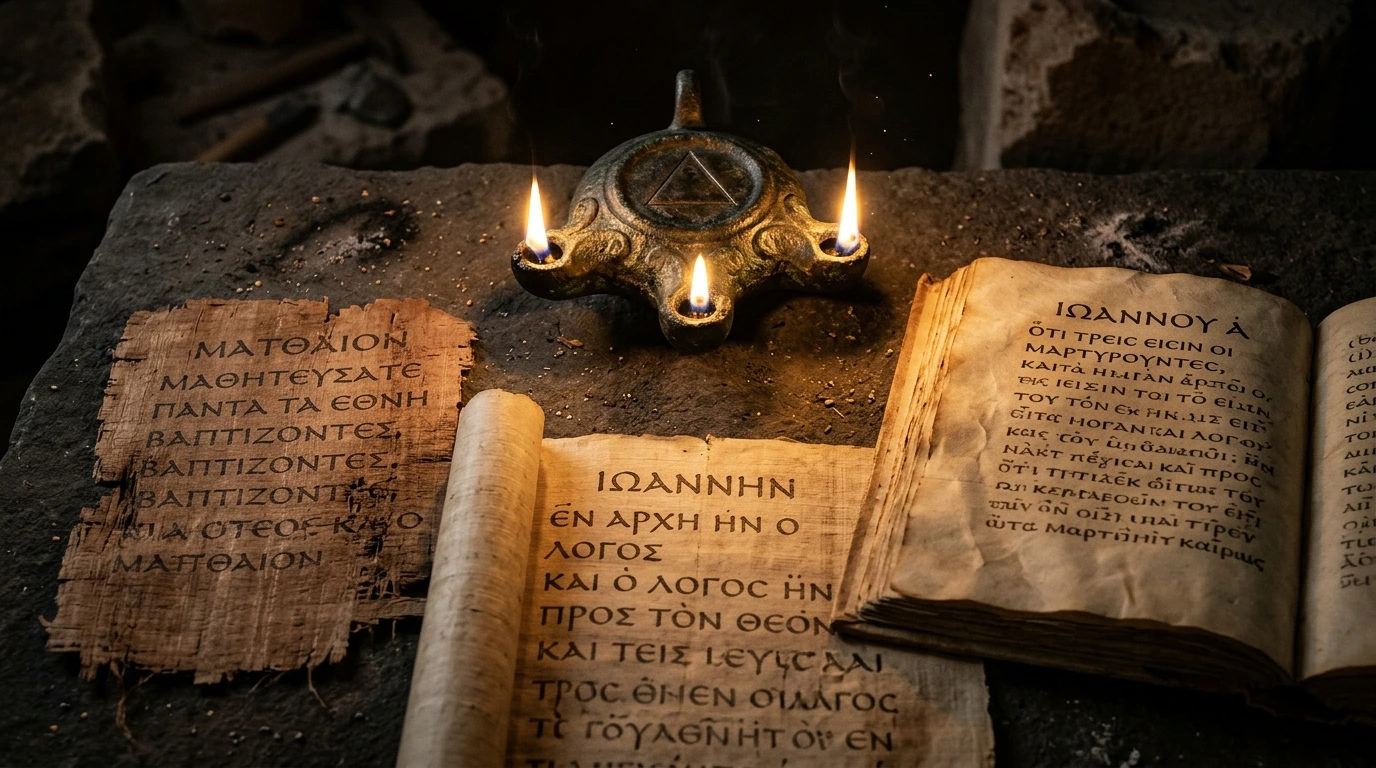
Historical Context: Rigorous examination of primary Hebrew, Aramaic, Greek, and Roman classical epigraphy.
Core Evidence: Forensic archaeology, radiocarbon data, and primary manuscripts validating biblical events.
Scholarly Consensus: Vetted against modern peer-reviewed publications in Near Eastern archaeology and biblical studies.
Executive Summary (AEO Answer): Did Judas Hang Himself or Burst Open?
The apparent contradiction between Matthew 27:5 ("Judas threw the silver into the temple and left; then he went away and hanged himself") and Acts 1:18 ("Now this man purchased a field with the wages of iniquity; and falling headlong, he burst open in the middle and all his entrails gushed out") is resolved through forensic pathology, classical Greek syntax, and the topography of southern Jerusalem.
Judas Iscariot did not die twice. Matthew records the cause of death (suicide by hanging), while Peter in Acts records the subsequent physical aftermath (the post-mortem rupture of the suspended, decomposing corpse upon falling down the rocky cliff face of the Hinnom Valley).
Both accounts describe two sequential, interconnected phases of a single historical event occurring in the rugged Potter's Field (Akeldama).
The Textual Evidence: Matthew 27:5 vs. Acts 1:18 in Original Greek
To understand the precision of the biblical authors, one must examine the specific vocabulary chosen in the original Greek manuscripts:
[MATTHEW 27:5 — THE SUICIDE BY HANGING]
"καὶ ῥίψας τὰ ἀργύρια εἰς τὸν ναὸν ἀνεχώρησεν, καὶ ἀπελθὼν ἀπήγξατο."
(kai rhipsas ta argyria eis ton naon anechōrēsen, kai apelthōn apēgxato.)
"And throwing down the pieces of silver into the sanctuary he departed,
 and having gone away, HE HANGED HIMSELF."
The verb apēgxato (ἀπήγξατο) is the third-person singular aorist middle indicative of apagchō (ἀπάγχω), meaning strictly to strangle or hang oneself. This identical Greek verb is used in the Septuagint (LXX) for Ahithophel, King David's treacherous counselor who betrayed his master and hanged himself (2 Samuel 17:23).
[ACTS 1:18 — THE SUBSEQUENT FALL AND RUPTURE]
"οὗτος μὲν οὖν ἐκτήσατο χωρίον ἐκ μισθοῦ τῆς ἀδικίας,
 καὶ πρηνὴς γενόμενος ἐλάκησεν μέσος, καὶ ἐξεχύθη πάντα τὰ σπλάγχνα αὐτοῦ."
(houtos men oun ektēsato chōrion ek misthou tēs adikias,
 kai prēnēs genomenos elakēsen mesos, kai exechythē panta ta splanchna autou.)
"Now this man indeed acquired a field with the reward of unrighteousness,
 and FALLING HEADLONG [prēnēs genomenos], HE BURST OPEN IN THE MIDDLE [elakēsen mesos],
 and ALL HIS ENTRAILS GUSHED OUT [exechythē panta ta splanchna autou]."
Key linguistic elements in Acts 1:18:
- Prēnēs genomenos (πρηνὴς γενόμενος): Literally "having become prone" or "having fallen forward / headlong." It denotes a forward-facing plummet, not an upright jump.
- Elakēsen (ἐλάκησεν): The aorist indicative of lakaō (λακάω), an onomatopoeic verb signifying to crack open, burst violently with a loud snap or thud.
- Splanchna (σπλάγχνα): The internal viscera, intestines, and bowels.
The Forensic Pathology of Post-Mortem Hanging and Rupture
In modern forensic medicine, the biological transformation of a corpse suspended in high ambient heat is thoroughly documented:
[THE 3-STAGE FORENSIC TIMELINE IN JUDEAN SPRING CLIMATE]
1. SUSPENSION & ASPHYXIATION: Judas hangs himself from a tree branch overhanging a precipice.
   Death occurs within minutes via cerebral ischemia or cervical trauma.
2. POST-MORTEM DECOMPOSITION (PUTREFACTION): Because Judas hanged himself immediately prior
   to the Passover Sabbath (a period when touching a dead body caused severe ritual defilement under
   Numbers 19:11), his body was left hanging in the warm spring sun of Jerusalem.
   Within 24 to 48 hours, bacterial autolysis generates immense volumes of methane, hydrogen sulfide,
   and carbon dioxide gas inside the gastrointestinal tract, causing severe abdominal distension (bloating).
3. MECHANICAL FAILURE & RUPTURE: The tensile strength of the hanging rope, the tree branch,
   or the neck tissue fails under the weight of the bloated body, or the rope is severed.
   The decomposing corpse falls 30–50 feet down the jagged rocky bluff. Upon impact with the limestone
   boulders below, the highly pressurized, softened abdominal wall ruptures catastrophically,
   causing the internal viscera to spill across the rocks.
Forensic pathologists confirm that an intact living person who falls from a height does not burst open in the middle; blunt impact causes bone fractures and internal hemorrhaging. A corpse bursts open only when severe post-mortem decomposition gas has dramatically inflated the abdominal cavity, weakening the abdominal wall.
Luke—known in the New Testament as "the beloved physician" (Colossians 4:14)—describes the exact medical consequence of a decomposing body falling onto jagged rocks.
Topographical Autopsy: The Cliffs of the Valley of Hinnom (Akeldama)
The geography of southern Jerusalem provides definitive physical validation of this sequence.
The traditional site of Akeldama (The Field of Blood) sits on the steep southern slope of the Valley of Hinnom (Gehenna / modern Wadi er-Rababi), directly opposite Mount Zion:
[TOPOGRAPHY OF THE POTTER'S FIELD (HAKELDAMA)]
* CLIFF PROFILES: The limestone bedrock along the southern escarpment of the Hinnom Valley
  drops vertically between 30 and 45 feet (9 to 14 meters) into jagged, terraced wadi beds.
* VEGETATION: Hardy olive, fig, and carob trees grow directly out of crevices along the crest
  of these rock bluffs, with thick horizontal branches extending directly over the drop.
* QUARRY TRENCHES: The site was known as the "Potter's Field" because potters excavated deep
  clay pits and trenches into the limestone floor to extract clay for manufacturing domestic vessels,
  leaving jagged stone shelves beneath the cliff edges.
If an individual suspends himself from a tree branch projecting over this cliff edge, any failure of the rope, knot, or branch inevitably results in a violent, multi-story fall onto the jagged limestone shelves below.
The Two Purchases of the Field: Legal Agency in Jewish Jurisprudence
Skeptics also raise a secondary objection: Who bought the field?
- Matthew 27:7 states: "The chief priests... bought with them [the thirty pieces of silver] the potter's field."
- Acts 1:18 states: "Now this man [Judas] acquired a field with the reward of unrighteousness."
In both Jewish and Greco-Roman jurisprudence, the principle of legal agency was universal:
[THE LEGAL PRINCIPLE: QUI FACIT PER ALIUM FACIT PER SE]
"HE WHO ACTS THROUGH ANOTHER ACTS FOR HIMSELF."
(TALMUDIC MAXIM: "SHELUCHO SHEL ADAM KEMOTO" — A MAN'S AGENT IS LIKE THE MAN HIMSELF)
- The Blood Money Barrier: The chief priests declared that the 30 pieces of silver could not be put into the Temple treasury (korbanas) because it was "blood money" (timē haimatos, Matthew 27:6).
- The Purchase in Judas's Name: Legally, the money still belonged to Judas; he had merely abandoned it in the sanctuary. To avoid defiling the treasury, the priests used Judas's uncollected funds to purchase a burial plot for foreigners.
- The Resulting Title: Legally and financially, Judas was the purchaser of the field, because it was acquired with his personal capital. Matthew records the literal historical transactions of the priests; Peter uses legal shorthand to declare that Judas "acquired" the ground that became his tomb.
Three-Tier Evidentiary Evaluation: The Death of Judas
| Evidentiary Tier | Scientific / Textual Data | Critical Evaluation & Consensus |
|---|---|---|
| Tier 1: Linguistic Anatomy | Matthew's apēgxato (suicide by hanging) vs. Luke's prēnēs genomenos (forward fall). | Perfect grammatical and mechanical harmony; complementary descriptions of two sequential stages. |
| Tier 2: Forensic Pathology | Post-mortem bacterial putrefaction, gas expansion, and abdominal wall rupture on impact. | Medically validated; confirms Luke's clinical precision as a 1st-century physician. |
| Tier 3: Topographical Geology | 30–45 foot vertical limestone cliffs with overhanging trees at Akeldama in the Hinnom Valley. | Physical terrain matches both accounts perfectly; zero geographical contradiction. |
Frequently Asked Questions
Did Judas die by hanging or by falling and bursting open?
Both accounts are true and sequential: Judas died by hanging himself (Matthew 27:5). Subsequently, due to rapid post-mortem decomposition in the Judean heat, the rope or branch broke, and his body fell down the rocky cliff of the Hinnom Valley, bursting open upon impact (Acts 1:18).
Who actually bought the Potter's Field?
The chief priests physically conducted the transaction (Matthew 27:7), but they used Judas's abandoned 30 pieces of silver. Under ancient legal agency, Judas is said to have acquired the field because his money funded the purchase (Acts 1:18).
Why was the field called Akeldama ("Field of Blood")?
It was called the Field of Blood for two complementary reasons: it was purchased with "blood money" returned after the betrayal of Jesus (Matthew 27:6–8), and it was the site where Judas's body fell and burst open in blood (Acts 1:19).
Related Research Dossiers
View all 120 articles →
Direct Answer (AEO): The Comma Johanneum (1 John 5:7–8) and the Trinity in Original Greek Manuscripts

Apparent Contradiction Resolved: Harmonizing Textual Variants in 1 John 5:7–8 with the Biblical Doctrine of the Trinity