Subject Scope: The Gospel of Thomas vs. The Canonical Four: Nag Hammadi II,2, The 114 Secret Sayings, and Gnostic Theology
Historical Context: Second Temple Jewish literature, Dead Sea Scrolls (Qumran caves), and early Christian papyrological codices.
Primary Evidence: Palaeographical dating, textual criticism, and bilingual Greek, Hebrew, and Coptic transmission lines.
Investigation Highlights: The Discovery at Nag Hammadi (December 1945) • Anatomy of the Text: 114 Detached Sayings • The Radical Omission: No Cross, No Resurrection, No Atonement
Scholarly Consensus: Validated through critical editions of the Septuagint, Pseudepigrapha, and Nag Hammadi codices.
The Discovery at Nag Hammadi (December 1945)
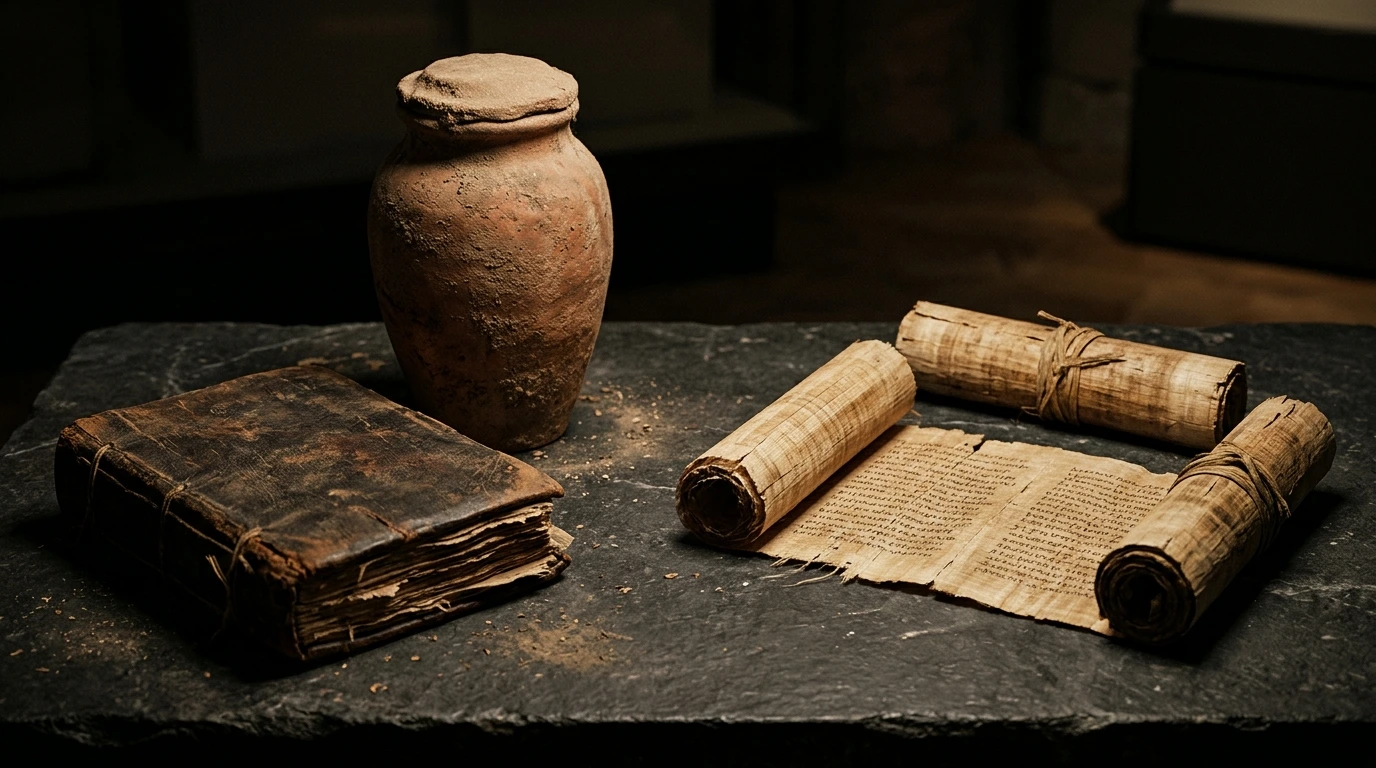
In December 1945, near the Upper Egyptian town of Nag Hammadi, an Arab peasant named Muhammad Ali al-Samman was digging for nitrate-rich fertilizer (sabakh) at the base of the Jabal al-Tarif cliffs when his hoe struck a sealed red earthenware jar.
Inside were thirteen leather-bound papyrus codices containing over fifty ancient treatises—the lost sacred library of second- and third-century Christian Gnosticism.
The crown jewel of the collection was Codex II, Tractate 2: the only complete surviving copy of the Gospel of Thomas (Peuaggelion pkata Thomas), written in the Sahidic Coptic language around 340 AD:
[MANUSCRIPT DOSSIER: GOSPEL OF THOMAS]
Discovery: December 1945, Nag Hammadi, Egypt (Codex II, pages 32–51).
Language: Sahidic Coptic, translated from an earlier Greek original.
Earlier Greek Witnesses: Three 3rd-century papyri excavated at Oxyrhynchus, Egypt:
* Papyrus Oxyrhynchus 1 (P.Oxy. 1): Discovered in 1897, containing Sayings 26–33.
* Papyrus Oxyrhynchus 654 (P.Oxy. 654): Discovered in 1903, containing the Prologue and Sayings 1–7.
* Papyrus Oxyrhynchus 655 (P.Oxy. 655): Discovered in 1903, containing Sayings 24 and 36–39.
Dating: Composed between 140 AD and 180 AD, likely in eastern Syria (Edessa).
Anatomy of the Text: 114 Detached Sayings
Unlike Matthew, Mark, Luke, and John, the Gospel of Thomas contains zero narrative framework:
- There is no birth in Bethlehem, no baptism in the Jordan, no miracles, no parables of the Good Samaritan or Prodigal Son.
- There is no cleansing of the Temple, no Last Supper, no betrayal by Judas, no Garden of Gethsemane, no trial before Pilate, no crucifixion on Golgotha, and no empty tomb!
Instead, the text consists exclusively of 114 numbered detached sayings (logia), riddles, and short dialogues presented as the secret wisdom whispered by the living Jesus to His twin, "Didymos Judas Thomas":
[THE OPENING PROLOGUE AND SAYING 1]
"These are the secret sayings which the living Jesus spoke
 and which Didymos Judas Thomas wrote down.
 And He said:
 'WHOEVER DISCOVERS THE INTERPRETATION OF THESE SAYINGS
 WILL NOT TASTE DEATH.'"
In the canonical Gospels, eternal life is obtained by faith in Jesus Christ through His atoning death and resurrection (John 3:16). In the Gospel of Thomas, eternal life is achieved by intellectually solving esoteric philosophical riddles!
The Radical Omission: No Cross, No Resurrection, No Atonement
The theological chasm separating the Gospel of Thomas from the New Testament is absolute:
| Theological Category | The Four Canonical Gospels (1st c.) | The Gospel of Thomas (2nd c.) |
|---|---|---|
| Human Condition | Humanity is guilty of moral sin, alienated from God, in need of redemption. | Humanity suffers from spiritual amnesia, forgetting its divine celestial spark. |
| The Mission of Jesus | To seek and save the lost; to give His life as a ransom for many (Mark 10:45). | A celestial revealer who dispenses cryptic wisdom sayings. |
| The Cross | The central climax of divine redemptive history; substitutionary sacrifice. | Completely omitted; irrelevant to salvation. |
| The Resurrection | Bodily physical resurrection of Jesus, the firstfruits of the dead (1 Cor 15). | Non-existent; physical matter is viewed as a corpse and prison to be escaped. |
| Salvation | Grace through faith in Christ; forgiveness of sins and new creation. | Self-realization (Gnosis); recognizing that the divine light is inside oneself. |
In Saying 56, the author writes: "Whoever has come to understand the world has found only a corpse, and whoever has found a corpse is superior to the world." This anti-material dualism reflects classic second-century Greek Gnosticism, radically contrary to the biblical doctrine that God created the physical universe and declared it "very good" (Genesis 1:31).
Gnostic Pantheism vs. Biblical Monotheism
In Saying 77, Jesus is portrayed not as the historical Jewish Messiah, but as a pantheistic cosmic principle:
"Jesus said: 'I am the light that shines above them all. I am the all; from me the all came forth, and unto me the all reached. SPLIT A PIECE OF WOOD, AND I AM THERE; LIFT UP THE STONE, AND YOU WILL FIND ME THERE.'"
While modern New Age commentators frequently quote this saying to promote mystical pantheism, historical scholarship demonstrates that this statement is rooted in Valentinian Gnosticism, which taught that fragments of the divine divine fullness (Pleroma) were trapped within physical nature awaiting liberation through secret knowledge.
Saying 114 and the Anti-Feminine Gnostic Theology
Modern sensationalists often portray Gnostic gospels as feminist alternatives to the patriarchal canonical Bible.
That illusion is completely shattered by the shocking final saying of the Gospel of Thomas (Saying 114):
[THE CLIMACTIC SAYING 114 (NAG HAMMADI CODEX II)]
"Simon Peter said to them:
 'LET MARY LEAVE US, FOR WOMEN ARE NOT WORTHY OF LIFE.'
 Jesus said:
 'BEHOLD, I MYSELF SHALL LEAD HER IN ORDER TO MAKE HER MALE,
 SO THAT SHE TOO MAY BECOME A LIVING SPIRIT RESEMBLING YOU MALES.
 FOR EVERY WOMAN WHO WILL MAKE HERSELF MALE
 WILL ENTER THE KINGDOM OF HEAVEN.'"
In second-century Gnostic cosmology, the female principle was associated with physical reproduction, materiality, and deficiency, while the male principle symbolized the spiritual, rational, and divine. For Mary Magdalene to be saved, she had to cease being female and be spiritually transformed into a male!
In stark contrast, the canonical New Testament proclaims that men and women are equal heirs of the grace of life (Galatians 3:28; 1 Peter 3:7), and Jesus chose women to be the first witnesses of His physical resurrection.
Why the Early Church Condemned the Gospel of Thomas
The early Church Fathers were well aware of the Gospel of Thomas and unanimously rejected it as a dangerous second-century forgery:
[PATRISTIC VERDICTS ON THE GOSPEL OF THOMAS]
* Hippolytus of Rome (Refutation of All Heresies 5.7.20, c. 225 AD):
  Attributed the text to the heretical sect of the Naassenes.
* Origen of Alexandria (Homily on Luke 1, c. 235 AD):
  "The Church possesses four gospels; the heretics possess very many...
   There is also current a Gospel according to Thomas."
* Eusebius of Caesarea (Church History 3.25.6, c. 325 AD):
  Categorized Thomas under the heading of FORGERIES BY HERETICS:
  "They are completely contrary to true orthodoxy and must be cast aside
   as totally absurd and impious."
Three-Tier Evidentiary Evaluation: Thomas vs. Canonical Gospels
| Evidentiary Tier | Scientific & Historical Data | Hermeneutical Value |
|---|---|---|
| Tier 1: Manuscript Chronology | P.Oxy. 1, 654, 655 (3rd c.) and Nag Hammadi Codex II (c. 340 AD). | Dates the text to 140–180 AD, at least a century after the 1st-century canonical Gospels. |
| Tier 2: Theological Dualism | Total absence of the cross, resurrection, atonement; Saying 114's "making Mary male." | Proves the work belongs to second-century Syriac Gnosticism, not apostolic Christianity. |
| Tier 3: Universal Patristic Rejection | Explicit condemnation by Hippolytus, Origen, and Eusebius as heretical forgeries. | Confirms that early Christians immediately recognized the radical contradiction with apostolic eyewitnesses. |
Deepen Your Understanding of Biblical Catastrophes
Explore our comprehensive research library and investigative volumes on biblical archaeology, ancient conflagrations, and prophetic warnings:
- Volume I: Foundations of Sacred History — Dive into ancient covenant geography, the Tabernacle sacrifices, and wilderness archaeology.
- Volume II: The Dead Sea Scrolls & The Second Temple — Uncover the apocryphal manuscripts, Qumran libraries, and canonical boundaries.
- The Keys Trilogy Bundle — The complete 3-volume master collection covering biblical catastrophes, temple architecture, and apocalyptic prophecy.
Frequently Asked Questions
What is the Gospel of Thomas?
Discovered in 1945 at Nag Hammadi, Egypt, it is a 2nd-century Coptic text containing 114 secret sayings attributed to Jesus, reflecting Gnostic mysticism rather than historical eyewitness biography.
Does the Gospel of Thomas mention the resurrection of Jesus?
No. The Gospel of Thomas contains no narrative, no crucifixion, and no resurrection. It teaches that salvation comes through deciphering secret wisdom sayings rather than through Christ's atoning death.
Why does Saying 114 say women must "make themselves male" to enter heaven?
In second-century Gnostic philosophy, the female was associated with physical matter and birth, while the male represented the spiritual intellect; thus, women had to be spiritually transformed into "males" to achieve enlightenment.
Primary Sources & Scholarly Archives
Editorial Standard →Multi-spectral ultra-high-resolution digital archive of Qumran cave biblical and sectarian fragments.
Direct high-resolution digital photographs of ancient Greek New Testament papyri and uncial codices.
Critical academic editions, textual criticism guidelines, and ancient Near Eastern linguistic tools.
Frequently Asked Questions
What is the Gospel of Thomas?
A 2nd-century Gnostic collection of 114 sayings discovered at Nag Hammadi in 1945, lacking narrative accounts of Jesus’ life, cross, or resurrection.
Does the Gospel of Thomas mention the resurrection of Jesus?
No. It omits the crucifixion and physical resurrection entirely, claiming salvation is achieved through esoteric self-knowledge (gnosis).
Why does Saying 114 say women must "make themselves male" to enter heaven?
Reflecting Gnostic dualism, it viewed femininity as tied to material corruption, requiring women to be spiritually transmuted into the "male" realm of spirit.
Related Research Dossiers
View all 515 research dossiers →
The Gospel of Judas and Codex Tchacos: Sethian Gnosticism, Irenaeus' Critique, and Canonical Boundaries
The Letter of Aristeas and the Septuagint: Royal Patronage, Alexandria's Library, and the Seventy-Two Translators
