Table of Contents (Summary)
- Introduction: The Cataclysm of 70 AD
- The Prophecy of Jesus in Olivet Discourse
- Titus’ Siege Tactics: Roman Siege Engines and Wall Breaches
- The Burning of the Holy of Holies and Destruction of Royal Stoa
- Josephus Records: Famine, Factional War, and Casualties
- The Arch of Titus Reliefs in Rome (Spoils of Jerusalem)
- Frequently Asked Questions
## Introduction: The Cataclysm of 70 AD {#introduction}
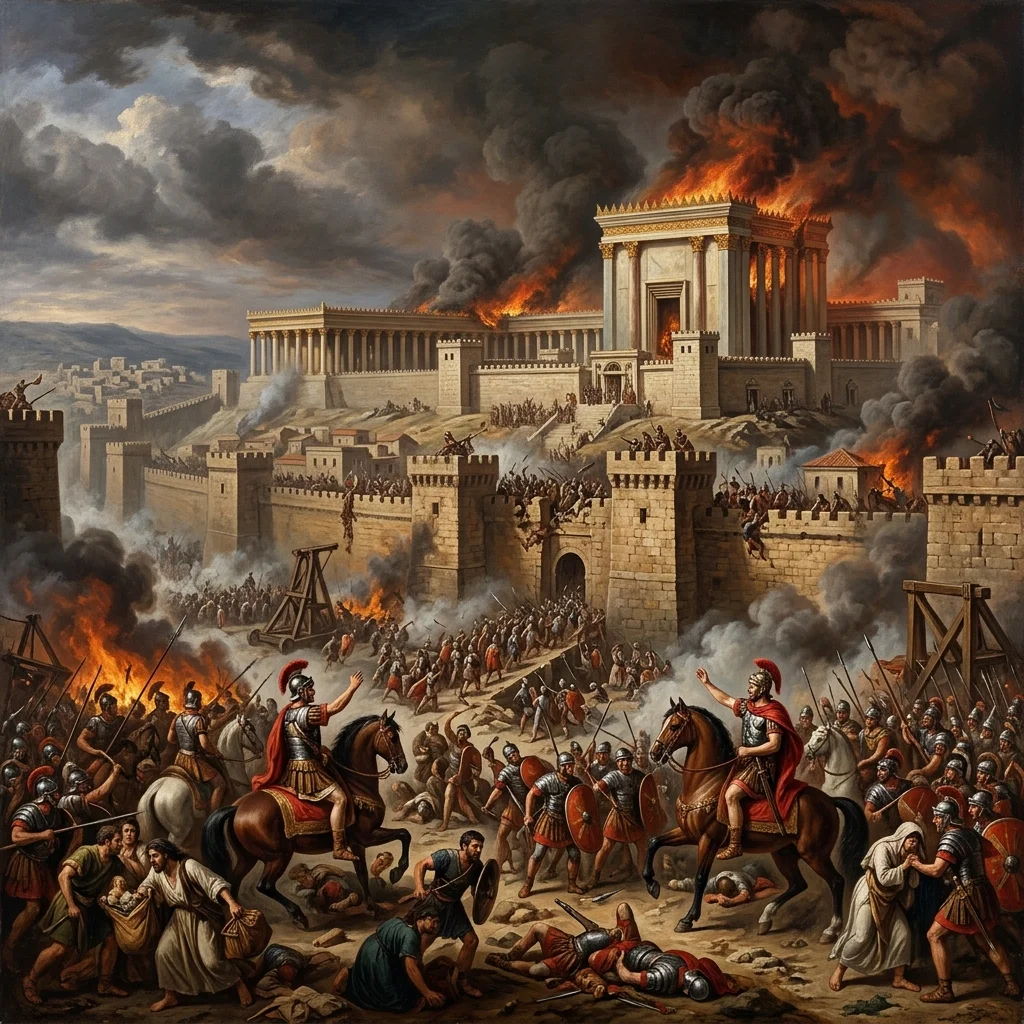
In the spring of 70 AD, four Roman legions under the command of General Titus (son of Emperor Vespasian)—Legio V Macedonica, Legio XII Fulminata, Legio XV Apollinaris, and Legio X Fretensis—encircled Jerusalem to crush the First Jewish-Roman Revolt.
What followed was a five-month siege culminating in one of the most violent military catastrophes of antiquity: the total destruction of Jerusalem and the burning of Herod’s Second Temple.
The Prophecy of Jesus in Olivet Discourse
Forty years prior to the siege (c. 30 AD), Jesus stood on the Mount of Olives overlooking the grand white marble and gold facade of the Second Temple, delivering a startling prophecy recorded in Mark 13:2 and Matthew 24:2:
*"Do you see all these great buildings?" Jesus replied. "Not one stone here will be left on another; every one will be thrown down."*
Romans soldiers stripped every gilded stone from the Temple mount to melt down melted gold leaf that had run into crevices during the fire, fulfilling Jesus' prophecy to the letter.
Titus’ Siege Tactics: Roman Siege Engines and Wall Breaches
Roman military engineers erected a 5-mile wooden siege wall (*circummuratio*) around Jerusalem in three days to prevent anyone from escaping.
- **Siege Towers & Battering Rams**: Romans deployed massive iron-tipped battering rams (*Victrix*) against the Third and Second North walls of Jerusalem. - **Catapults & Ballistae**: Roman artillery hurled 1-talent (75-pound) white limestone stones over 400 meters into residential quarters.
The Burning of the Holy of Holies and Destruction of Royal Stoa
According to Flavius Josephus (*Jewish War*, Book VI), Titus desired to preserve the Temple building as a trophy of Roman victory. However, on the 10th of Ab (August 70 AD), a Roman soldier threw a burning brand through a golden window into the chambers surrounding the Sanctuary.
The cedarwood paneling ignited instantly. Flames consumed the Royal Stoa, the Court of the Women, and the Holy of Holies. The immense heat melted golden vessels, causing liquid gold to seep between limestone paving stones.
Josephus Records: Famine, Factional War, and Casualties
Josephus records that over **1.1 million people perished** during the siege due to catastrophic famine, plague, and intense infighting between Jewish zealot factions (led by John of Gischala and Simon bar Giora).
Over 97,000 survivors were sold into Roman slavery or forced into gladiatorial arenas across the empire.
The Arch of Titus Reliefs in Rome (Spoils of Jerusalem)
Following the victory, Emperor Vespasian and Titus celebrated a colossal Roman Triumph in 71 AD. The wealth plundered from Jerusalem financed the construction of the **Roman Colosseum** (*Amphitheatrum Flavium*).
Standing today at the Via Sacra in Rome, the **Arch of Titus** features explicit 1st-century stone carvings depicting Roman soldiers carrying spoils from the Jerusalem Temple: - The solid gold **Seven-Branched Menorah** - The **Table of Showbread** - The silver **Sacred Trumpets**
This monumental relief stands as undeniable physical archaeological proof confirming Josephus’ accounts and biblical history.
Frequently Asked Questions
When was the Second Temple in Jerusalem destroyed?
The Second Temple was burned and completely destroyed by Roman legions under Titus on the 10th of Ab in 70 AD.
Does the Arch of Titus in Rome show items from the Jerusalem Temple?
Yes, 1st-century stone reliefs on the Arch of Titus clearly depict Roman soldiers carrying the solid gold Menorah, Table of Showbread, and silver trumpets taken from Jerusalem.
How did Jesus prophesy the destruction of the Temple?
In Matthew 24:2, Jesus predicted that not one stone of the Temple would be left upon another—a prophecy fulfilled when Romans dismantled stones to retrieve melted gold.