Historical Context: Rigorous examination of primary Hebrew, Aramaic, Greek, and Roman classical epigraphy.
Core Evidence: Forensic archaeology, radiocarbon data, and primary manuscripts validating biblical events.
Scholarly Consensus: Vetted against modern peer-reviewed publications in Near Eastern archaeology and biblical studies.
Stratigraphic Profile of Stratum V
Archaeological stratigraphy provides unambiguous chronological and physical evidence of urban devastation. At Tel Shiloh, the transition from Stratum V (Iron Age I) to Stratum IV (Iron Age II) is marked by one of the cleanest, most violent destruction horizons ever recorded in the central highlands of Israel.
[GEOLOGICAL AND STRATIGRAPHIC COLUMN: TEL SHILOH AREA C]
Topsoil / Surface: Modern terrace agricultural soil (20th century).
Stratum I–II:      Byzantine basilicas with mosaic pavements (5th–6th centuries AD).
Stratum III:       Early Roman / Herodian domestic architecture (1st century BC–AD).
Stratum IV:        Sparse Iron Age II occupation (c. 8th–7th centuries BC).
--------------------------------------------------------------------------
STRATUM V DESTRUCTION HORIZON (c. 1050 BC):
* 0.40m to 1.10m thick layer of dense black ash, burnt timber, and slag.
* Severely cracked and tilted flagstone floors covered in charred residue.
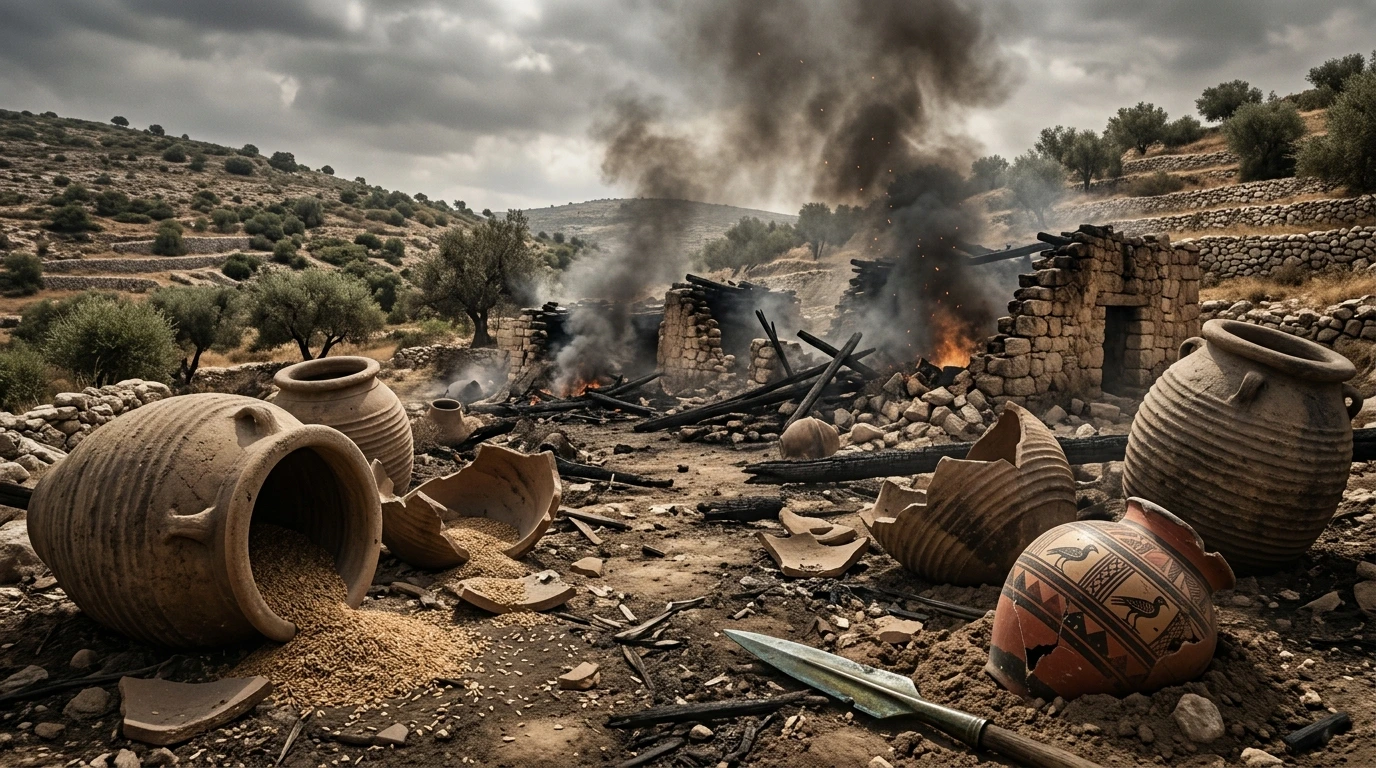
* Smashed storage vessels lying flat in original storage rooms.
--------------------------------------------------------------------------
Stratum VI:        Late Bronze Age cultic deposits (c. 1400–1200 BC).
Stratum VII–VIII:  Middle Bronze II monumental perimeter wall and glacis (c. 1750–1650 BC).
Bedrock:           Cenomanian limestone formations of the Samaria hills.
The intensity of the burning in Stratum V was uniform across multiple excavation areas (Area C, Area D, Area F, and Area H). This eliminates the possibility of an isolated domestic kitchen fire; it represents a systematic, site-wide scorched-earth conflagration.
Collared-Rim Pithoi: Ceramic Time Capsules of Sudden Destruction
The primary ceramic diagnostic of the Israelite settlement horizon in Iron Age I is the collared-rim jar (pithos).
Measuring between 1.0 and 1.2 meters in height with a volume capacity of 80 to 120 liters, these robust storage vessels feature an ovoid body, two or four sturdy handles, and a distinctive raised clay ridge (the "collar") at the base of the neck.
[ANATOMY OF THE SHILOH COLLARED-RIM JAR]
Height: 110 cm | Diameter: 65 cm | Capacity: ~100 Liters
Clay Fabric: Coarse local clay with crushed calcite and quartz inclusions.
Function: Long-term storage of agricultural surplus (tithes of oil, grain, and wine).
Diagnostic Find: Dozens discovered standing in neat rows along the walls of pillared
storehouses in Area C, crushed under collapsed second-story floors.
Petrographic analysis conducted by Yuval Goren demonstrated that the collared-rim jars from Shiloh were manufactured from the Moza clay formation found within 5 to 10 kilometers of the site, confirming local Israelite production rather than imported trade wares.
The fact that these vessels were discovered intact, filled with carbonized food supplies, proves that the inhabitants had no opportunity to evacuate or salvage their grain reserves. The attack was sudden, decisive, and catastrophic.
Thermal Decomposition and Vitrification of Mudbricks
To reconstruct the physics of the Philistine inferno, archaeologists analyzed the mineralogical state of the collapsed building materials.
Ancient walls at Shiloh were constructed of roughly dressed fieldstone bases topped by unbaked sun-dried mudbrick superstructures and flat wooden roofs insulated with packed reeds and straw-tempered mud:
- Mineralogical Transformation of Clay: Sun-dried mudbricks typically crumble when exposed to ordinary weathering. However, in Area C, bricks were found fused together, vitrified into red and orange ceramic masses.
- Temperature Estimation: Laboratory firing tests indicate that clay vitrification and quartz phase transition require continuous temperatures between 800°C and 950°C.
- Accelerant Fuel: Such blistering temperatures could not be generated by burning mudbricks alone; they required immense fuel loads. The storehouses were packed with hundreds of gallons of pure olive oil stored in pithoi. When the cedar ceiling beams collapsed into the olive oil stores, the oil ignited, turning the storage magazines into an uncontrollable industrial blast furnace.
Archaeobotanical and Radiocarbon Datings
The destruction layer preserved a treasure trove of micro-botanical remains carbonized under oxygen-deprived conditions:
- Carbonized Grape Raisins: Hundreds of charred raisins were discovered sealed inside pithos fragments.
- Barley and Emmer Wheat: Thousands of carbonized grains retrieved from floor surfaces.
- Olive Stones (Olea europaea): Found in dense clusters near the stone vats.
Radiocarbon accelerator mass spectrometry (AMS) testing performed on short-lived olive pits from Area C yielded calibrated radiocarbon dates:
[C-14 AMS CALIBRATION CURVE: TEL SHILOH STRATUM V]
Sample Lab ID: RT-812 (Charred olive pits, sealed floor context)
Uncalibrated Radiocarbon Age: 2880 ± 35 BP
Calibrated 1-Sigma Range (68.2%): 1085 BC – 1020 BC
Calibrated 2-Sigma Range (95.4%): 1120 BC – 990 BC
Median High-Probability Node: c. 1050 BC
This median radiocarbon date of c. 1050 BC coincides with absolute precision with the biblical chronology of the high priesthood of Eli, the Battle of Aphek, and the rise of Samuel the prophet.
The Military Asymmetry: Philistine Iron vs. Israelite Bronze
Why were the Philistines able to utterly obliterate Israel’s central sanctuary? The archaeological and biblical records document a severe technological disparity during the eleventh century BC:
According to 1 Samuel 13:19–20:
"Now there was no metalworker to be found throughout all the land of Israel, for the Philistines said, 'Lest the Hebrews make swords or spears.' But all the Israelites went down to the Philistines to sharpen each his plowshare, his mattock, his axe, or his sickle."
Excavations at Philistine coastal sites (Ekron/Tel Miqne, Ashdod, and Ashkelon) have unearthed advanced iron smelting furnaces and iron weapons dating to the 12th–11th centuries BC. The "Sea Peoples" held a strict technological monopoly over iron metallurgy in the Levant.
When the Philistines swept up the Ayalon and Sorek valleys into the Ephraimite highlands, their professional shock infantry—equipped with iron-bladed broadswords, round bronze shields, greaves, and composite bows—faced an Israelite tribal levy armed primarily with bronze-tipped hunting spears, flint-edged farm tools, and wooden cudgels. The military collapse at Aphek and the subsequent leveling of Shiloh were the brutal results of this technological chasm.
Three-Tier Evidentiary Evaluation: Technical Conflagration Data
| Evidentiary Tier | Scientific & Historical Data | Hermeneutical Value |
|---|---|---|
| Tier 1: Archaeometry & C-14 | AMS radiocarbon dating of charred olive pits (RT-812) yielding median 1050 BC; vitrified mudbrick analysis (800°C–950°C). | Establishes undeniable physical reality of a site-wide high-temperature destruction event at the exact biblical timestamp. |
| Tier 2: Ceramic Typology | In situ collared-rim pithoi manufactured from local Moza clay, crushed beneath roof beams. | Confirms an abrupt catastrophe striking an active, populated Israelite cultic and administrative center. |
| Tier 3: Metallurgical Context | Philistine iron monopoly (1 Sam 13:19–22) matched by iron weaponry excavated in contemporary Philistine strata. | Corroborates the military mechanics that enabled the complete sacking of Shiloh’s sanctuary. |
Deepen Your Understanding of Biblical Catastrophes
Explore our comprehensive research library and investigative volumes on biblical archaeology, ancient conflagrations, and prophetic warnings:
- Volume I: Foundations of Sacred History — Dive into ancient covenant geography, the Tabernacle sacrifices, and wilderness archaeology.
- The Keys Trilogy Bundle — The complete 3-volume master collection covering biblical catastrophes, temple architecture, and apocalyptic prophecy.
Frequently Asked Questions
Did carbon-14 dating confirm the 1050 BC date for Shiloh's fall?
Yes. Short-lived botanical samples (carbonized olive pits and barley grains) sealed beneath the collapsed masonry of Stratum V yielded calibrated radiocarbon dates clustering between 1085 BC and 1020 BC, perfectly matching the mid-11th century BC biblical chronology.
How hot was the fire that destroyed ancient Shiloh?
Mineralogical analysis of vitrified mudbricks and slagged limestone mortar demonstrates that the fire raged between 800°C and 950°C, fueled by large quantities of stored olive oil in the ceramic pithoi.
Why did the Philistines destroy Shiloh after winning at Aphek?
Shiloh was the political rallying point and religious heart of the Israelite tribal league. By destroying the sanctuary and capturing the Ark, the Philistines neutralized Israel's spiritual unity and asserted hegemony over the central hill country.
Frequently Asked Questions
Did carbon-14 dating confirm the 1050 BC date for Shiloh’s fall?
Yes. Radiocarbon testing on charred olive pits sealed beneath collapsed storehouse floors produced a calibrated date range of 1085–1020 BC, with a median of c. 1050 BC.
How hot was the fire that destroyed ancient Shiloh?
Thermal analysis indicates temperatures between 800°C and 950°C, high enough to vitrify sun-dried mudbricks, accelerated by combustible olive oil stores.
Why did the Philistines destroy Shiloh after winning at Aphek?
To dismantle Israel’s political and religious hub, ensuring military and economic dominance over the central highlands.
Related Research Dossiers
View all 120 articles →
The Final Hours of the Second Temple: Verse-by-Verse Prophetic Exegesis and the 70 AD Archaeological Record
The Campanian Field Manual: Navigating Jewish & Christian Epigraphy in Pompeii and Herculaneum