Subject Scope: The Tabernacle at Tel Shiloh Field Guide: Sacred Geography, Sacrificial Faunal Remains, and Prophetic Memory
Historical Context: Ancient Near Eastern stratigraphy, Levant archaeological surveys, and Semitic epigraphy.
Primary Evidence: Monumental stelae, bullae seals, ceramic typology, and calibrated AMS radiocarbon determinations.
Investigation Highlights: Sacred Geography: The Secluded Valley of Ephraim • The Northern Platform: Dimensions of the Bedrock Cutting • The Bone Deposits: Levitical Sacrificial Anatomy
Scholarly Consensus: Aligned with published excavation reports from leading Near Eastern archaeological institutes.
Sacred Geography: The Secluded Valley of Ephraim
To understand why God led Joshua to place the Tabernacle at Shiloh, one must examine its sacred topography.
Unlike Jerusalem, which sat perched upon the fortified ridges of Mount Moriah along the central north-south ridge route, Shiloh was deliberately established in a secluded natural amphitheater:
- Geographical Position: Situated in the territory of Ephraim, north of Bethel, south of Lebonah, and east of the main highway (Judges 21:19).
- Topographical Shielding: Ringed by surrounding hills, Shiloh is completely invisible until one ascends the final ridge into the basin.
- Perennial Water Supply: The spring of Ein Seilun (located 800 meters northeast) provided an abundant, gravity-fed water source essential for tens of thousands of annual pilgrims and the heavy water requirements of Levitical animal sacrifices.
This natural seclusion fostered an atmosphere of reverent sanctuary away from the pagan trade caravans traveling the King’s Highway or the Via Maris.
The Northern Platform: Dimensions of the Bedrock Cutting
For decades, scholars debated the exact physical location of the Tabernacle tent within the 30-acre expanse of Tel Seilun. Recent architectural surveys directed by Dr. Scott Stripling on the northern plateau have identified an extraordinary artificial bedrock terrace:
[SURFACE ARCHITECTURAL MEASUREMENTS: NORTHERN PLATEAU]
Length of Leveled Bedrock: 50 meters (~100 cubits)
Width of Leveled Bedrock:  25 meters (~50 cubits)
Orientation: Perfectly aligned on an East-West axis (Entrance facing due East).
Rock-Cut Postholes: Sockets carved into the bedrock along the perimeter,
matching the spacing required for the wooden courtyard posts of Exodus 27.
The dimensions of this artificial terrace (50 × 25 meters) match with astronomical fidelity the biblically commanded dimensions of the Courtyard of the Tabernacle (Chatzar HaMishkan): 100 cubits long by 50 cubits wide (Exodus 27:9–13).
Moreover, the eastern approach features a natural stone ramp descending toward the water source, accommodating the ceremonial movement of the priests and animals.
The Bone Deposits: Levitical Sacrificial Anatomy
The most compelling empirical confirmation of the sacrificial cult at Tel Shiloh comes from the faunal osteological record.
In the bone dumps excavated immediately outside the northern terrace walls, zooarchaeologists processed over 100,000 animal bone fragments spanning the Late Bronze and Iron Age I periods. The statistical profile of these remains reveals remarkable conformance to the dietary and sacrificial statutes of Leviticus:
[ZOOARCHAEOLOGICAL ANALYSIS: SHILOH BONE DUMPS]
1. Species Distribution:
   * 100% Kosher Sacrificial Domesticates: Sheep (Ovis aries), Goats (Capra hircus),
     and young Cattle (Bos taurus).
   * 0% Pig (Sus scrofa) bones (in stark contrast to Philistine coastal sites where
     pig bones constitute 15% to 25% of faunal assemblages).
   * 0% Canine, equine, or camel bones in the cultic stratum.
2. Age Profile:
   * Over 70% of sheep/goat bones belonged to animals under one year of age,
     matching the biblical requirement for yearling sacrificial lambs (Leviticus 23:12).
3. Anatomical Asymmetry (The Right-Sided Preference):
   * A statistically anomalous preponderance of bones from the RIGHT side of the animal
     (right shoulders and right limbs), perfectly reflecting Leviticus 7:32–34:
     "And the right thigh you shall give to the priest as a heave offering."
No other archaeological site in the ancient Near East exhibits this specific right-sided anatomical distribution. It is concrete physical proof that the Levitical sacrificial system recorded in the Pentateuch was practiced verbatim on this hillside.
The Ceramic Pomegranate and Cultic Horns
In addition to bone assemblages, excavations at Shiloh have brought to light sacred ritual artifacts:
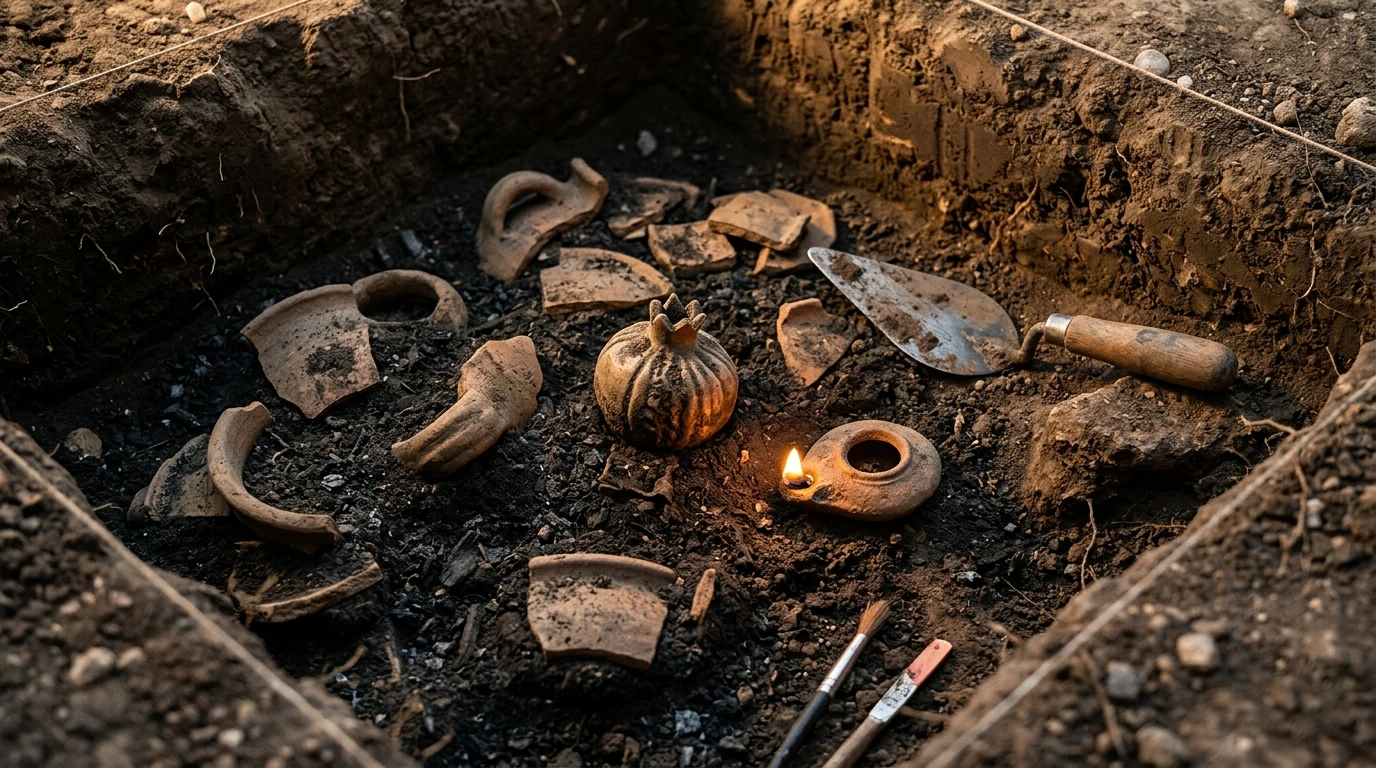
- The Ceramic Pomegranate: Uncovered during wet-sifting in 2018, this miniature ceramic pomegranate measures just 5 cm in length and features a perforated neck for suspension. In the Torah, pomegranates made of blue, purple, and scarlet yarn alternated with golden bells along the hem of the High Priest’s robe (Exodus 28:33–35). This artifact is dated to the Late Bronze / Iron I transition.
- Four-Horned Altar Stone: A corner stone carved with a distinct projecting "horn" (keren) was discovered embedded in secondary use in later Byzantine walls, preserving physical remnants of an ancient stone altar at the site.
- Kikar (Talent) Weight Stones: Precision-carved limestone balance weights utilized for weighing silver shekels brought as tithes and temple redemption taxes.
Theological Post-Mortem: The Crisis of Ichabod
The fall of Shiloh marked a fundamental watershed in Israel’s theological history:
[THE THEOLOGICAL LESSON OF ICHABOD]
The Sin: Treating the Ark of God as a magical talisman or military mascot.
The Judgment: God permits the heathen to destroy His own earthly dwelling place.
The Name: Ichabod (אִי־כָבוֹד) = "No Glory" or "Where is the Glory?"
The Reality: God will not be manipulated by outward ritual when personal holiness,
justice, and covenant obedience are abandoned.
The disaster forced Israel to confront the terrifying reality that God’s presence is not tied to physical real estate. The golden Ark could be captured; the holy city could be burned; the high priest’s lineage could be cut down.
When King David later established Jerusalem as the new capital, he brought the Ark to Zion with trembling, remembering what had happened at Shiloh. And when Jeremiah stood in the courts of Solomon’s Temple, Shiloh was the ultimate prophetic paradigm: outward religion without inner repentance guarantees catastrophic judgment.
Three-Tier Evidentiary Evaluation: Cultic Archaeology at Shiloh
| Evidentiary Tier | Scientific & Historical Data | Hermeneutical Value |
|---|---|---|
| Tier 1: Zooarchaeology | Over 100,000 faunal bones showing 100% kosher species, yearling age, and right-sided priestly portion preference. | Provides physical, anatomical verification of the Levitical sacrificial ritual in action. |
| Tier 2: Architectural Alignment | Rock-cut terrace on northern plateau measuring 50 × 25 meters aligned East-West. | Demonstrates that an enclosure matching the 100 × 50 cubit Tabernacle courtyard stood at the site. |
| Tier 3: Cultic Small Finds | Ceramic pomegranate with suspension loop, horned altar fragment, and ritual pottery chalices. | Directly links the material culture of Tel Seilun to the sacred vestments and furniture of the High Priest. |
Deepen Your Understanding of Biblical Catastrophes
Explore our comprehensive research library and investigative volumes on biblical archaeology, ancient conflagrations, and prophetic warnings:
- Volume I: Foundations of Sacred History — Dive into ancient covenant geography, the Tabernacle sacrifices, and wilderness archaeology.
- The Keys Trilogy Bundle — The complete 3-volume master collection covering biblical catastrophes, temple architecture, and apocalyptic prophecy.
Primary Sources & Scholarly Archives
Editorial Standard →Official archaeological field reports, certified stratigraphy surveys, and Semitic epigraphy catalogs.
Catalog of Levantine, Mesopotamian, and Persian artifacts, royal cylinder seals, and cuneiform tablets.
Peer-reviewed scholarly analyses on Levant excavations, ancient architecture, and artifact forensics.
Frequently Asked Questions
Where was the Tabernacle located within Tel Shiloh?
On the northern bedrock terrace, where artificial rock cuttings match the 100 × 50 cubit dimensions of the Tabernacle courtyard, aligned East-West.
What is the significance of the animal bones found at Shiloh?
The bones are 100% kosher sacrificial species, primarily yearling lambs and goats, with an anomalous right-sided anatomical preference matching Leviticus 7.
Why is Ichabod such a pivotal concept in biblical theology?
It marks the solemn reality that God will remove His presence and permit His sanctuary to be destroyed when worship becomes an empty, corrupt ritual.
Related Research Dossiers
View all 515 research dossiers →
The Final Hours of the Second Temple: Verse-by-Verse Prophetic Exegesis and the 70 AD Archaeological Record
The Campanian Field Manual: Navigating Jewish & Christian Epigraphy in Pompeii and Herculaneum