Table of Contents (Summary)
## The 1947 Qumran Discovery {#discovery}
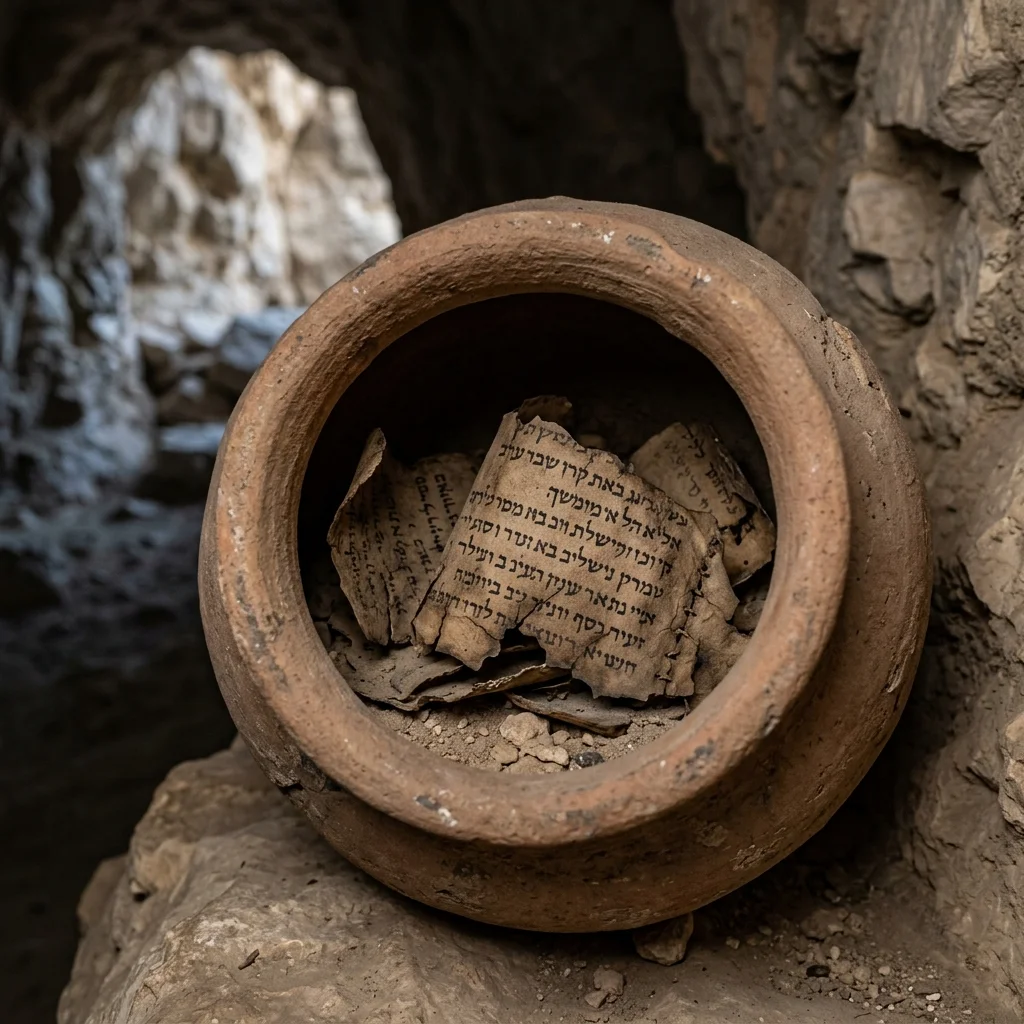
In the winter of 1947, a Bedouin shepherd named Muhammed edh-Dhib threw a stone into a limestone cave along the northwestern shore of the Dead Sea, hearing the sound of shattering pottery. Inside, he discovered clay storage jars containing ancient leather scrolls wrapped in linen.
This accidental finding launched the greatest archaeological discovery of the 20th century: the **Dead Sea Scrolls of Qumran**. Between 1947 and 1956, eleven caves yielded over 25,000 scroll fragments representing more than 900 distinct manuscripts created between 250 BC and 68 AD by the Jewish Essene community.
The Great Isaiah Scroll (1QIsa-a)
Among the initial discoveries in Cave 1 was the **Great Isaiah Scroll (1QIsa-a)**—a complete, beautifully preserved leather scroll measuring 7.34 meters (24 feet) in length, containing all 66 chapters of the Book of Isaiah written in ancient Hebrew uncial script.
Carbon-14 dating and paleographic analysis date 1QIsa-a to approximately **125–100 BC**. Prior to 1947, the oldest extant Hebrew manuscript of Isaiah was the **Leningrad Codex**, copied in **1008 AD**. The Qumran discovery instantly bridged a massive **1,000-year manuscript gap**.
Comparing 1QIsa-a with the Leningrad Codex
When textual scholars led by Millar Burrows and William F. Albright compared the 100 BC Dead Sea Scroll with the 1008 AD Masoretic text, the results astonished academia.
Scholars found that after 1,000 years of manual copying by Jewish scribes (*Masoretes*), the two texts were **over 95% identical word-for-word**. The remaining 5% of variations consisted almost entirely of minor spelling variations (orthography), grammatical plene spellings, and minor slips of the pen that did not alter a single historical fact or theological doctrine.
"It is a matter of wonder that through something like a thousand years the text underwent so little change." — Millar Burrows, *The Dead Sea Scrolls* (1955)
Cave 4 Excavations and Biblical Manuscripts
While Cave 1 contained the best-preserved scrolls, **Cave 4** produced the vast bulk of the Qumran library. Excavated in 1952, Cave 4 contained over 40,000 fragmented pieces representing more than 500 individual manuscripts.
Every single book of the Hebrew Old Testament was identified among the Qumran manuscripts except Esther. Cave 4 yielded multiple copies of Deuteronomy, Psalms, and Isaiah, alongside early Greek Septuagint fragments and Aramaic Targums.
Prophetic Preservation: Isaiah 53 Servant Song
One of the most crucial passages tested for scribal preservation was **Isaiah 53**—the famous Messianic "Suffering Servant" prophecy.
In Isaiah 53, containing 166 words in Hebrew, scholars identified only **13 letter variations** between 1QIsa-a and the medieval Masoretic Text: - 11 of these variations were purely stylistic or spelling preferences (such as adding a vowel letter *vav*). - 1 variation was a single light-refinement word in Isaiah 53:11 where 1QIsa-a reads *"out of the suffering of his soul he shall see **light**"*—a reading confirmed by the Greek Septuagint (LXX) copied in 200 BC.
This remarkable consistency demolished 19th-century liberal claims that Isaiah 53 was a late Christian interpolation inserted into Jewish Bibles after the time of Christ.
Impact on Modern Old Testament Textual Criticism
The discovery of the Dead Sea Scrolls established the extraordinary fidelity of Jewish scribal traditions (*soferim*). Scribes meticulously counted every letter, middle word, and line of every biblical book, ritually destroying any scroll with a single copying error.
The Dead Sea Scrolls proved to modern scholarship that the Old Testament text read today is an exceptionally accurate transmission of ancient Hebrew prophecy dating back to the Second Temple era.
Frequently Asked Questions
How old is the Great Isaiah Scroll found at Qumran?
The Great Isaiah Scroll (1QIsa-a) dates to between 125 BC and 100 BC, making it over 1,000 years older than the oldest medieval Hebrew manuscripts previously known.
How accurate was the text of Isaiah after 1,000 years of copying?
Textual scholars proved that the 100 BC Dead Sea Scroll text and the 1008 AD Masoretic text are over 95% identical, with variations limited mostly to minor spelling preferences.
Which biblical books were found in Cave 4 at Qumran?
Cave 4 yielded thousands of fragments from every Old Testament book except Esther, with the highest number of copies belonging to Psalms, Deuteronomy, and Isaiah.