Table of Contents (Summary)
## The 1968 Giv’at HaMivtar Discovery {#discovery}
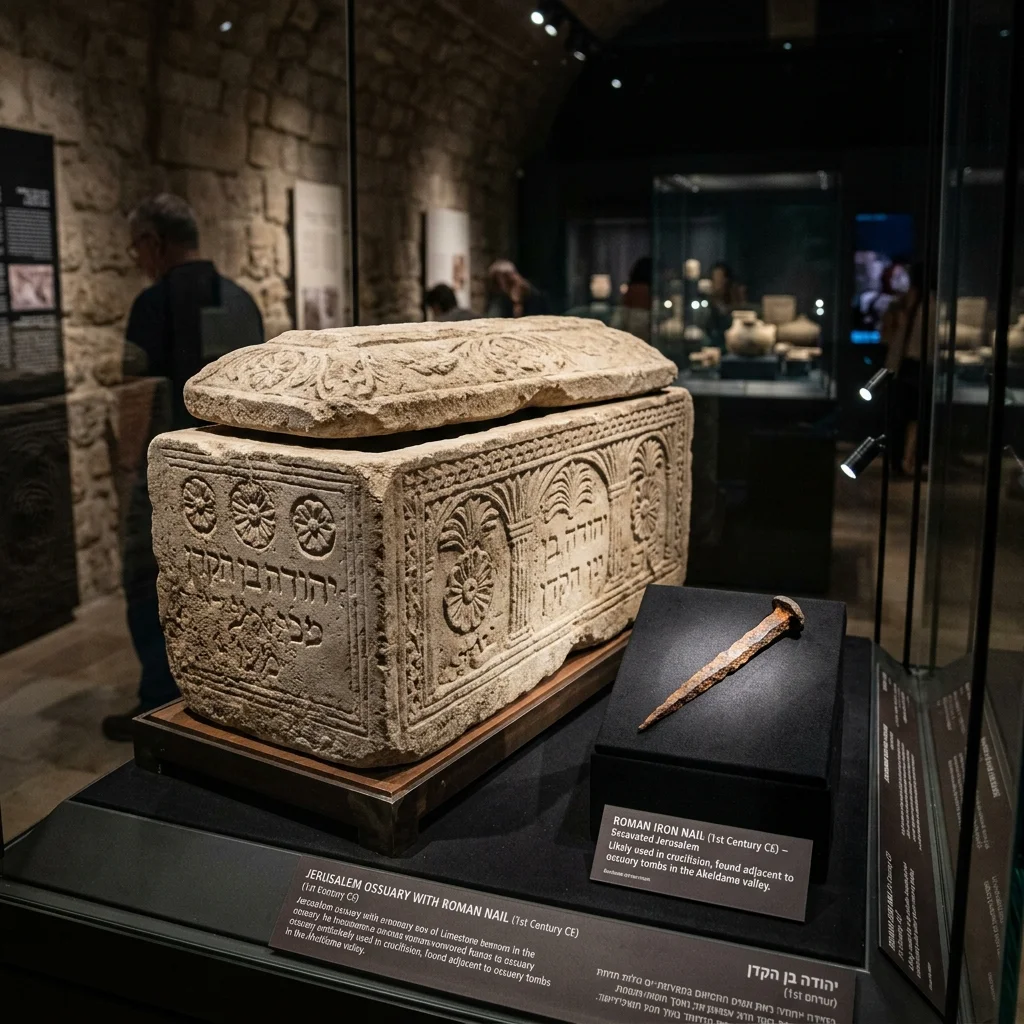
In June 1968, building contractors excavating a suburb in northern Jerusalem (Giv’at HaMivtar) uncovered an ancient Jewish tomb complex dating from the 1st century BC to 70 AD.
Israeli archaeologist Dr. Vassilios Tzaferis examined the limestone burial boxes (*ossuaries*). Inside Ossuary No. 4, inscribed with the Hebrew name **Jehohanan ben Hagkol** ("Jehohanan, son of Hagkol"), researchers discovered the skeletal remains of a young man aged 24 to 28.
Strikingly, Jehohanan’s right heel bone (*calcaneus*) was still pierced by a heavy Roman iron nail measuring 11.5 centimeters (4.5 inches) in length, surrounded by fragments of acacia wood.
Anatomical Analysis of the Calcaneus (Heel Bone)
Anthropological examination at the Hadassah Medical Center revealed that the iron nail had been driven through the lateral side of the right heel bone.
Why was the nail still embedded in the bone?
1. When the Roman executioner hammered the nail through Jehohanan’s feet into the olive-wood upright post (*stipes*), the tip of the iron nail struck a hard knot in the wood, **bending the tip into a hook**. 2. Following death, Jehohanan’s family attempted to remove the body for burial. Because the iron tip was bent like a fishhook inside the wood, they could not pull the nail out without taking a piece of the wooden cross upright along with the calcaneus. 3. The family severed the foot with the nail intact and placed it inside the burial chamber.
Reconstructing the Roman Execution Method
The Jehohanan discovery provided the world’s first direct empirical proof of how Roman soldiers executed victims in 1st-century Judea:
- **Lateral Nailing**: Instead of nailing both feet together flat against the front of the cross, the victim’s feet were placed astride the vertical beam (*stipes*), with an iron nail driven horizontally through each calcaneus into the side of the wood. - **Sedile (Small Wooden Seat)**: Forensic analysis indicated the presence of a small wooden peg or seat (*sedile*) attached to the vertical beam. This was not a mercy, but a cruel device designed to prolong agony by allowing the victim to rest their weight briefly to take a breath. - **Forearm Nailing**: Nails were driven through the wrists (anatomically considered part of the hand in antiquity) near the **destot space** between the radius and carpal bones. This pierced the median nerve, inflicting blinding electrical neuralgia.
Asphyxiation and Pathological Cause of Death
Medical pathology demonstrates that Roman crucifixion caused death primarily through **progressive asphyxiation and hypovolemic shock**.
When hanging by suspended arms, the weight of the body pulls down on the pectoral and intercostal muscles, locking the lungs in a permanent state of inhalation. To exhale, the victim was forced to push upward using their nailed feet, scraping shredded back wounds against the rough wooden post.
Eventually, extreme exhaustion, lactic acidosis, dehydration, and pericardial effusion (fluid accumulation around the heart) triggered cardiac arrest.
Why Physical Evidence of Crucifixion is Extremely Rare
Scholars often questioned why thousands of Roman crucifixions left so little physical evidence in archaeology:
1. **Iron Recycling**: Iron was an expensive commodity; Roman soldiers routinely pulled nails out of corpses for re-use or sold them as magical amulets. 2. **Unburied Victims**: Most crucified victims were rebels or slaves who were denied proper burial, left to decompose or be eaten by wild animals on public hilltops. 3. **Wooden Spikes**: In many cases, executioners used wooden pegs or rope bindings rather than metal nails.
The Jehohanan discovery remains an extraordinary historical bridge confirming the literal physical reality of Gospel descriptions of Roman crucifixion in 1st-century Jerusalem.
Frequently Asked Questions
What was discovered in the Jehohanan ossuary in Jerusalem?
Archaeologists discovered a 1st-century heel bone (calcaneus) still pierced by a bent Roman iron crucifixion nail surrounded by olive wood fragments.
Why didn’t Roman soldiers remove the nail from Jehohanan’s foot?
The tip of the iron nail hit a hard knot in the olive wood cross and bent into a hook, preventing the soldiers from pulling it out after death.
How did crucified victims die according to medical science?
Victims died primarily from gradual asphyxiation, as hanging suspended prevented lung exhalation unless pushing up on nailed feet, eventually leading to cardiac arrest.