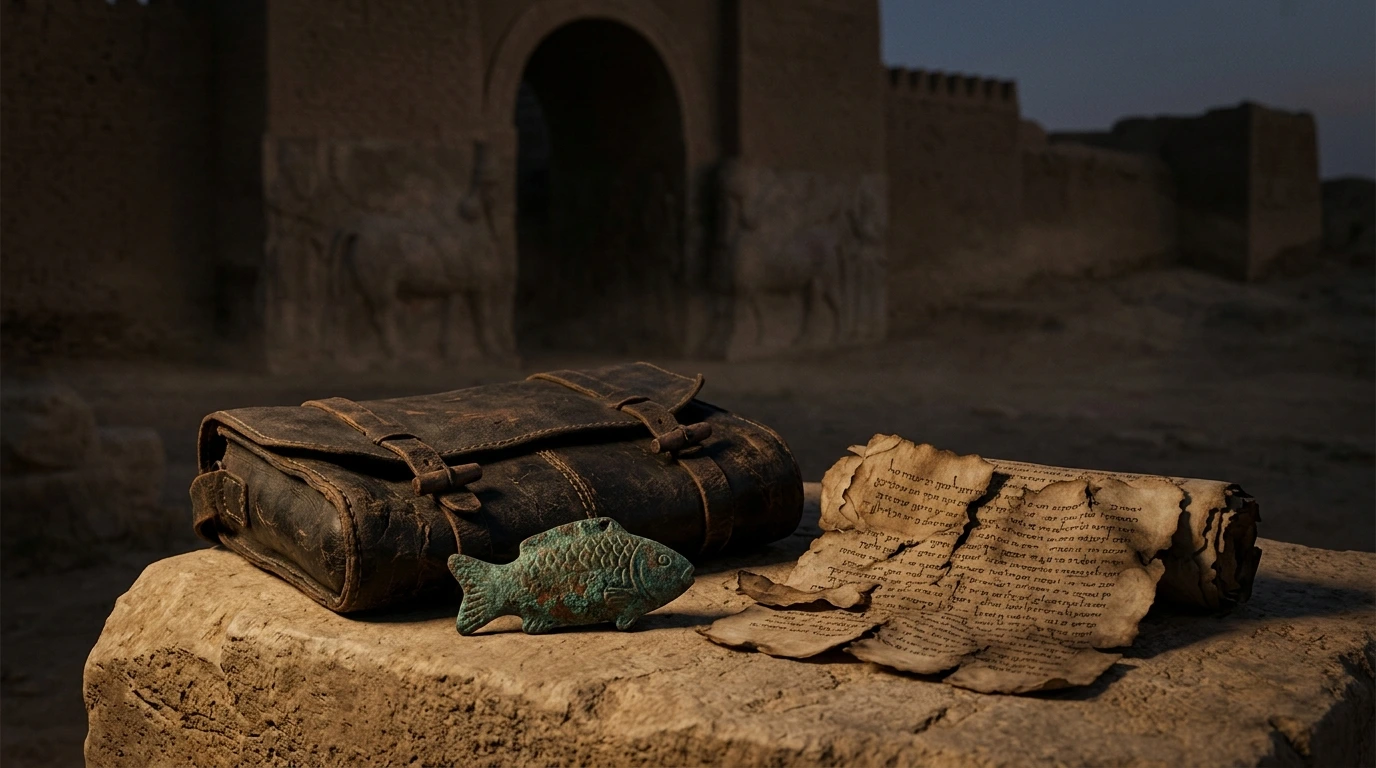
Subject Scope: Myths vs. Manuscript Facts: The Demon Asmodeus, Archangel Raphael, and the True Status of Tobit
Historical Context: Second Temple Jewish literature, Dead Sea Scrolls (Qumran caves), and early Christian papyrological codices.
Primary Evidence: Palaeographical dating, textual criticism, and bilingual Greek, Hebrew, and Coptic transmission lines.
Investigation Highlights: The Modern Controversies Surrounding Tobit • Myth 1: "The Dead Sea Scrolls Prove Tobit Belongs in the Protestant Bible" • Myth 2: "Tobit Teaches Occult Sorcery and Magic"
Scholarly Consensus: Validated through critical editions of the Septuagint, Pseudepigrapha, and Nag Hammadi codices.
The Modern Controversies Surrounding Tobit
The Book of Tobit sits at the historical epicenter of the Catholic-Protestant canonical divide.
For Roman Catholics and Eastern Orthodox Christians, it is a canonical, inspired book of the Old Testament. For Protestants and modern Jews, it is an apocryphal, non-inspired work.
In recent years, the internet has generated numerous misconceptions: claims that Protestant Reformers maliciously "ripped Tobit out of the Bible in the 1800s," that the Dead Sea Scrolls prove it was canonical, or that the book promotes witchcraft.
Examining the manuscripts, Church history, and patristic prefaces provides objective clarity.
Myth 1: "The Dead Sea Scrolls Prove Tobit Belongs in the Protestant Bible"
- The Viral Claim: Because five copies of Tobit were discovered in Qumran Cave 4 alongside Isaiah and Psalms, the ancient Jews accepted Tobit as canonical Scripture.
- The Manuscript Reality:
- Qumran Was Not a Closed Canon Library: Cave 4 contained over 500 distinct compositions. Alongside biblical books, the Essenes stored their own sectarian rulebooks (Community Rule 1QS, War Scroll 1QM), astrological horoscopes (4Q186), secular documents, and non-canonical commentaries (pesharim).
- The presence of a manuscript at Qumran proves that a text was read and copied, not that it was recognized as inspired Scripture.
- No Biblical Status in Hebrew Judaism: The Jewish community that canonized the Hebrew Bible (Tanakh) in Judea and Galilee never included Tobit in the tripartite canon of the Law, the Prophets, and the Writings.
Myth 2: "Tobit Teaches Occult Sorcery and Magic"
- The Viral Claim: Critics argue that using the burnt heart and liver of a fish to drive away the demon Asmodeus (Tobit 6:16–17) and using fish bile to cure blindness (Tobit 11:11–13) is demonic sympathetic magic forbidden by Deuteronomy 18.
- The Theological and Medical Reality:
- Ancient Pharmacopeia: In Greco-Roman and ancient Near Eastern medicine, fish gall (fel piscis) was widely documented by medical writers such as Pliny the Elder (Natural History 32.24) and Galen as a caustic substance used to remove leukoma (corneal white spots or cataracts).
- Physical Means for Spiritual Healings in Canonical Scripture: Canonical biblical narratives frequently depict God directing physical actions in miracles:
- In 2 Kings 20:7, the prophet Isaiah commands a cake of figs to be applied to King Hezekiah's deadly boil to heal him.
- In John 9:6, Jesus spits on the ground, makes clay with His saliva, and anoints the eyes of a blind man to restore his sight.
- In Tobit, the expulsion of Asmodeus is accompanied by fasting, prayer, and angelic command, not occult incantations. It is presented within a framework of trust in the God of Israel.
Myth 3: "Jerome Included Tobit in the Vulgate Because He Believed It Was Scripture"
- The Viral Claim: Saint Jerome translated Tobit into the Latin Vulgate because he recognized it as inspired word-for-word scripture.
- The Historical Reality (Jerome’s Own Words):
- In his famous Helmed Prologue (Prologus Galeatus) to the Books of Samuel and Kings (391 AD), Jerome listed the 24 books of the Hebrew Bible and stated bluntly:
"Whatever is beyond these must be reckoned among the apocrypha. Therefore, Wisdom, commonly entitled the Wisdom of Solomon, and the book of Jesus the son of Sirach, and Judith, and TOBIAS... ARE NOT IN THE CANON."
- Jerome translated Tobit reluctantly under intense pressure from two Italian bishops (Chromatius of Aquileia and Heliodorus of Altino).
- In his Preface to Tobit, Jerome famously admitted:
"I have satisfied your desire rather than my own inclination... I do not cease to wonder at the constancy of your demanding that I translate a book written in Chaldee [Aramaic] into Latin... I have done it in a single day’s labor!"
- Jerome explicitly affirmed that the Church reads Tobit "for the edification of the people, not for establishing the authority of ecclesiastical dogmas."
- In his famous Helmed Prologue (Prologus Galeatus) to the Books of Samuel and Kings (391 AD), Jerome listed the 24 books of the Hebrew Bible and stated bluntly:
The Council of Trent (1546) vs. The Protestant Reformation
The formal divergence over Tobit occurred in the sixteenth century:
[CANONICAL CHRONOLOGY: DEUTEROCANONICAL DEBATE]
1534: Martin Luther publishes his German translation, placing Tobit and six other books
      in a separate intertestamental section titled: "Apocrypha: These are books which
      are not held equal to the Sacred Scriptures, and yet are useful and good for reading."
1546: The Council of Trent (Fourth Session): In response to the Reformation, the Roman Catholic
      Church declares Tobit, Judith, Wisdom, Sirach, Baruch, and 1-2 Maccabees to be
      DEUTEROCANONICAL ("second canon"), pronouncing anathema on anyone who rejects them.
1646: The Westminster Confession of Faith (Protestant):
      "The books commonly called Apocrypha, not being of divine inspiration, are no part
      of the canon of the Scripture; and therefore are of no authority in the Church of God."
Three-Tier Evidentiary Evaluation: Deconstructing Tobit Controversies
| Evidentiary Tier | Scientific & Historical Data | Hermeneutical Value |
|---|---|---|
| Tier 1: Jerome’s Prefaces | Explicit statements in Prologus Galeatus and Praefatio in Tobiam defining Tobit as apocryphal. | Proves that the primary translator of the Latin Vulgate did not consider Tobit canonical scripture. |
| Tier 2: Qumran Library Context | Cave 4 containing hundreds of sectarian and secular manuscripts alongside Tobit. | Demonstrates that Dead Sea scroll presence does not equate to Hebrew Tanakh canonicity. |
| Tier 3: Classical Medicine | Documentation by Pliny the Elder and Galen confirming fish gall as an ancient cataract remedy. | Refutes claims of witchcraft; aligns the text with authentic Hellenistic Near Eastern medical practices. |
Deepen Your Understanding of Biblical Catastrophes
Explore our comprehensive research library and investigative volumes on biblical archaeology, ancient conflagrations, and prophetic warnings:
- Volume I: Foundations of Sacred History — Dive into ancient covenant geography, the Tabernacle sacrifices, and wilderness archaeology.
- Volume II: The Dead Sea Scrolls & The Second Temple — Uncover the apocryphal manuscripts, Qumran libraries, and canonical boundaries.
- The Keys Trilogy Bundle — The complete 3-volume master collection covering biblical catastrophes, temple architecture, and apocalyptic prophecy.
Primary Sources & Scholarly Archives
Editorial Standard →Multi-spectral ultra-high-resolution digital archive of Qumran cave biblical and sectarian fragments.
Direct high-resolution digital photographs of ancient Greek New Testament papyri and uncial codices.
Critical academic editions, textual criticism guidelines, and ancient Near Eastern linguistic tools.
Frequently Asked Questions
Did Protestant Reformers delete Tobit from the Bible?
No. Following Saint Jerome and ancient Jewish tradition, they relocated Tobit to an intertestamental section for historical reading rather than doctrinal authority.
Did Saint Jerome consider Tobit inspired Scripture?
No. Jerome explicitly stated in his prefaces that Tobit was apocryphal, translating it in a single day only under urgent pressure from friends.
Does the use of fish gall in Tobit constitute magic?
No. Fish gall was an established classical treatment for eye cataracts documented by Pliny the Elder, operating here under God’s healing providence.
Related Research Dossiers
View all 515 research dossiers →
The Gospel of Judas and Codex Tchacos: Sethian Gnosticism, Irenaeus' Critique, and Canonical Boundaries
The Letter of Aristeas and the Septuagint: Royal Patronage, Alexandria's Library, and the Seventy-Two Translators
