Historical Context: Rigorous examination of primary Hebrew, Aramaic, Greek, and Roman classical epigraphy.
Core Evidence: Forensic archaeology, radiocarbon data, and primary manuscripts validating biblical events.
Scholarly Consensus: Vetted against modern peer-reviewed publications in Near Eastern archaeology and biblical studies.
The Anatomy of the Sudden Squall (Lailaps)
Life rarely provides advance warning before a crisis strikes.
You are driving on the highway, and your phone rings with a devastating diagnosis from the oncologist. You walk into your office, and your supervisor hands you an immediate termination letter. You return home from work, and your spouse announces they are leaving.
In an instant, your physiological baseline is obliterated: your heart rate accelerates to 150 beats per minute, tunnel vision sets in, your breathing turns shallow and erratic, and cold terror paralyzes your vocal cords.
This is the psychological and spiritual reality recorded in Mark 4:35–41.
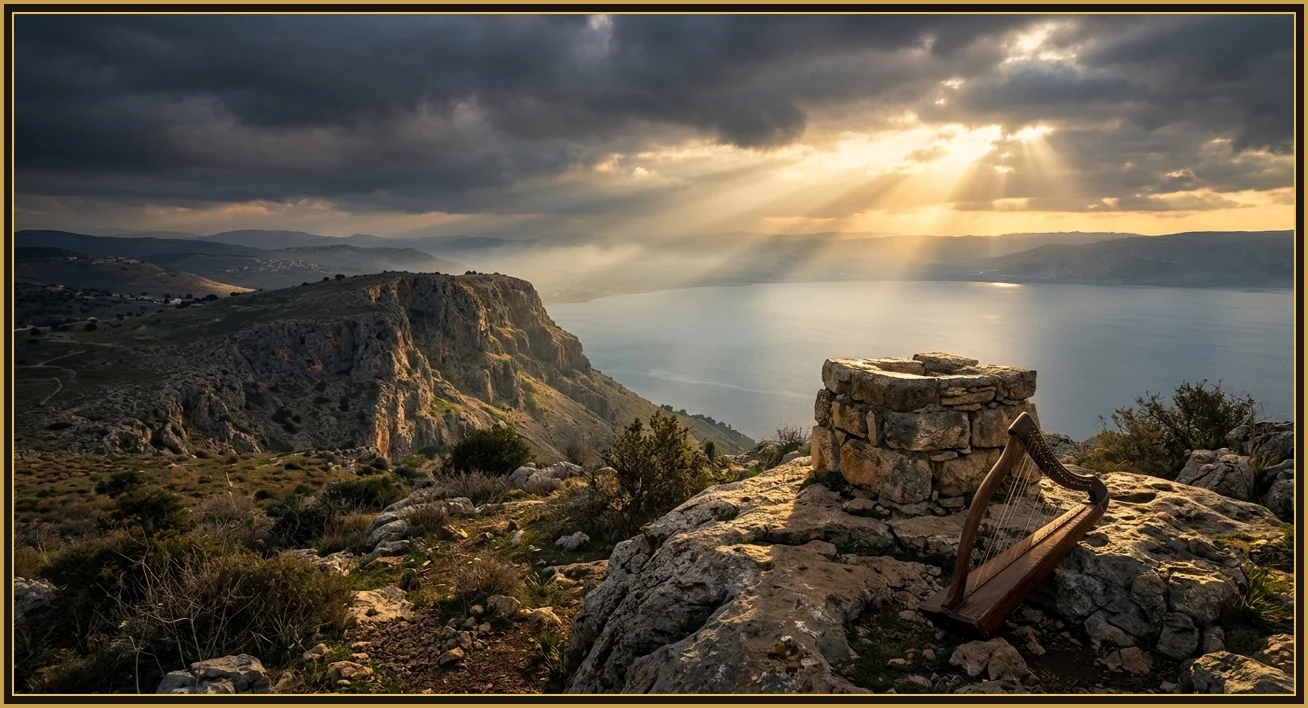
Jesus and His disciples were crossing the Sea of Galilee at dusk. Because the lake sits nearly 700 feet below sea level, surrounded by steep basalt ravines, cold downdrafts from Mount Hermon frequently collide with hot, humid air rising from the Jordan rift, generating catastrophic, localized hurricanes in minutes.
The Greek text uses the forensic term Lailaps Megalē Anemou (λαῖλαψ μεγάλη ἀνέμου).
A lailaps is not an ordinary thunderstorm; it is a violent, rotating whirlwind or microburst that descends out of nowhere, churning the lake into a vortex of whitecaps. The waves beat into the boat so furiously that the vessel was rapidly taking on water.
These disciples were not delicate landlubbers. Peter, Andrew, James, and John had spent their entire lives on this water. They knew maritime emergencies.
Yet when seasoned commercial fishermen begin screaming in terror, you know the ship is seconds away from sinking.
The Pillow in the Stern: Christ’s Supreme Poise
Where was Jesus during this existential crisis?
The text notes an astonishing detail:
"But He was in the stern, asleep on a pillow. And they awoke Him and said to Him, 'Teacher, do You not care that we are perishing?'" (Mark 4:38)
The boat was pitching violently, seawater was pouring over the gunwales, the hull was groaning under thousands of pounds of pressure—and the Son of God was sound asleep in the stern, resting His head upon a leather-covered oarsman’s cushion (proskephalaion).
How could anyone sleep inside a category-four hurricane?
Because Jesus understood who He was, whose He was, and what covenant authority meant.
He was not sovereignly governed by the barometric pressure of the Sea of Galilee. He carried the atmosphere of heaven inside His own spirit. You cannot quiet a storm around you until you carry the quiet of God within you.
The disciples rushed to Him in full panic: "Teacher, do You not care that we are perishing?" Notice their complaint: panic always attacks God’s character. It whispers: “God has abandoned you; God doesn't care about your pain.”
The Greek Autopsy: Siōpa, Pephimōso (Be Muzzled)
Look with breathless reverence at what happened next:
"Then He arose and rebuked the wind, and said to the sea, 'Peace, be still!' And the wind ceased and there was a great calm." (Mark 4:39)
Notice the sequence:
- He Rebuked the Wind (Epetimēsen): This is the exact legal and exorcistic verb Jesus used when commanding demons to exit tormented individuals (Mark 1:25). Jesus recognized that behind the physical squall operated a demonic spiritual agitation attempting to drown the Savior before He reached Golgotha.
- He Spoke Three Words to the Waves: In the Greek text, Jesus uttered two imperatives: Siōpa, Pephimōso! (Σιώπα, πεφίμωσο).
Let us unpack these two words:
- Siōpa: Present active imperative of siōpaō. It is a sharp, commanding military bark: “Silence! Hold your tongue! Cease your noise!”
- Pephimōso: Perfect passive imperative of phimoō. Phimoō means "to muzzle, gag, or bridle a rabid, wild animal."
Jesus was not asking the sea politely to calm down. He looked at the raging vortex like a master confronting a rabid, snarling wolf, and commanded: “BE MUZZLED AND STAY MUZZLED!”
And the reaction was instantaneous: "The wind ceased and there was a Mega Galēnē—a great, glass-like, mirror calm."
The waves did not slowly subside over forty minutes; the laws of physics yielded to the Creator. In a split second, the howling gale died, the swells flattened into marble, and absolute silence enveloped the boat.
The 90-Second Emergency Reset Protocol
When acute panic attacks your mind, your marriage, or your workplace, do not try to engage in an hour-long theological debate. Execute this 90-second Christological emergency reset:
Phase 1: Physiological Interruption (0 to 30 Seconds)
Stop moving. Plant both feet on the floor. Take three slow, diaphragmatic breaths: inhale for 4 seconds, hold for 4 seconds, exhale for 6 seconds. This manually overrides the sympathetic nervous system's fight-or-flight panic cycle and re-engages your prefrontal cortex.
Phase 2: Positional Alignment (30 to 60 Seconds)
Mentally look at the storm. Remember: Jesus is in the boat with you. If Jesus cannot drown, your life cannot drown! Remind yourself: “This situation does not have the final say. Christ is King over this crisis.”
Phase 3: The Vocal "Pephimōso" Decree (60 to 90 Seconds)
Open your mouth and speak aloud directly to the atmosphere of your heart and room:
“In the name of Jesus Christ, I speak peace to this storm! Fear, panic, and racing thoughts: BE MUZZLED! The peace of God reigns in my heart, and this crisis shall not destroy my destiny!”
The 3 Emergency Vocal Declarations for Acute Crisis
Keep these three emergency declarations memorized for moments of acute shock:
1. In the Face of Medical or Health Panic
“My body is the temple of the Holy Spirit. Christ took my infirmities and bore my sicknesses. I command my heartbeat to be steady, my blood pressure to align with divine health, and every spirit of sudden terror to leave this room. Amen!” (1 Peter 2:24; 2 Timothy 1:7)
2. In the Face of Financial or Legal Threat
“The Lord is my defense and the rock of my refuge. No weapon formed against my household shall prosper. God shall supply all my need according to His riches in glory by Christ Jesus. I walk in divine wisdom, and my steps are ordered!” (Psalm 94:22; Philippians 4:19)
3. In the Face of Family Confrontation or Rage
“Peace, be still in this home! I pull down the spirit of strife, anger, and accusation in Jesus' name. A soft answer turns away wrath; the gentleness of Christ governs my tongue and this atmosphere. Amen!” (Proverbs 15:1; Colossians 3:15)
Access the Complete 90-Second Emergency Declaration Index
The 90-Second Emergency Reset is the tactical centerpiece of Command Your Morning and Night: 60 Scriptural Declarations. Keep the full emergency index on your smartphone or nightstand for instant access in the day of trouble:
👉 Download Command Your Morning and Night: 60 Scriptural Declarations ($3.99)
Gain instant access to all 60 spoken morning and evening declarations, 4 fine-art sacred plates, original Hebrew roots, and the 90-second emergency crisis index.
🎁 Or Claim The Sacred Keys Complete Trilogy Bundle ($7.99 — 33% Off)
Own the complete library: Command Your Morning, The Solomon Code, and The 7 Biblical Keys for Silent Battles, complete with 19 museum-grade sacred plates.
Frequently Asked Questions
Why did Jesus rebuke the disciples for their fear after calming the storm?
Jesus did not rebuke them for waking Him; He rebuked them for their unbelief (deiloi - cowardice). Having witnessed His authority over disease and demons, they should have rested in the covenant reality that having Christ in their boat made them unsinkable, regardless of the storm's severity.
Can a believer speak to external circumstances with the same authority as Jesus?
Yes, within the boundaries of God’s covenant will. In Mark 11:23, Jesus explicitly taught: "Whoever says to this mountain, 'Be removed and be cast into the sea,' and does not doubt in his heart... he will have whatever he says." Believers do not speak in their own authority, but in the delegated name and blood covenant of Jesus Christ.
What should I do if the storm doesn't calm down immediately after I pray?
Recognize that God exercises His authority in two ways: either He silences the storm outside you (Mark 4:39), or He imparts supernatural peace inside you that makes you impervious to the storm (Philippians 4:7). Both are profound manifestations of divine victory.
Frequently Asked Questions
Why did Jesus rebuke the disciples for their fear after calming the storm?
Jesus did not rebuke them for waking Him; He rebuked them for their unbelief (deiloi - cowardice). Having witnessed His authority over disease and demons, they should have rested in the covenant reality that having Christ in their boat made them unsinkable, regardless of the storm’s severity.
Can a believer speak to external circumstances with the same authority as Jesus?
Yes, within the boundaries of God’s covenant will. In Mark 11:23, Jesus explicitly taught: Whoever says to this mountain, Be removed and be cast into the sea, and does not doubt in his heart... he will have whatever he says. Believers do not speak in their own authority, but in the delegated name and blood covenant of Jesus Christ.
What should I do if the storm doesn’t calm down immediately after I pray?
Recognize that God exercises His authority in two ways: either He silences the storm outside you (Mark 4:39), or He imparts supernatural peace inside you that makes you impervious to the storm (Philippians 4:7). Both are profound manifestations of divine victory.
Related Research Dossiers
View all 120 articles →
The Cost of an Undisciplined Tongue: How Careless Words Destroy Wealth and Influence
The First 15 Minutes: Why Your Morning Thoughts Are a Spiritual Battlefield