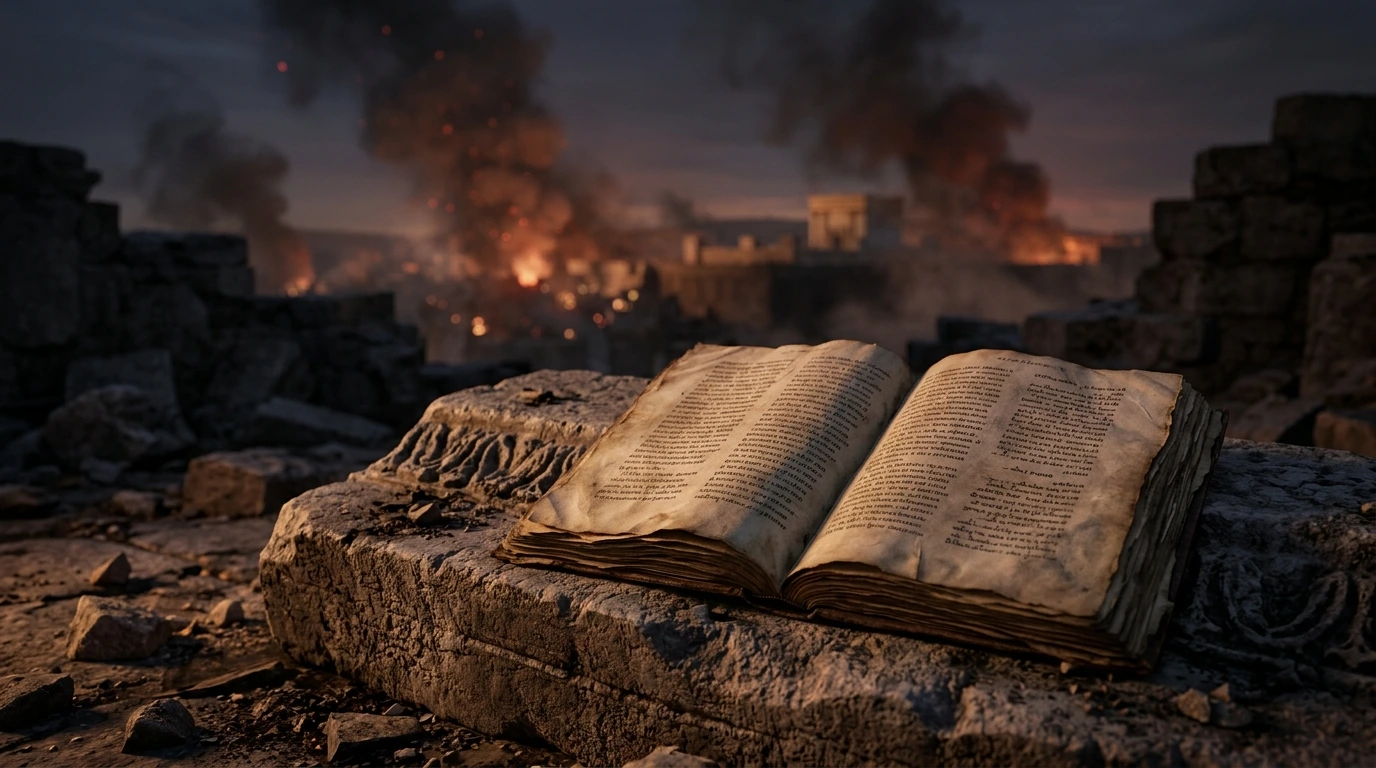
Subject Scope: Fourth Ezra (2 Esdras) and the Trauma of 70 AD: The Eagle Vision, the Seven Complaints, and the Problem of Evil
Historical Context: Second Temple Jewish literature, Dead Sea Scrolls (Qumran caves), and early Christian papyrological codices.
Primary Evidence: Palaeographical dating, textual criticism, and bilingual Greek, Hebrew, and Coptic transmission lines.
Investigation Highlights: The Identity of Fourth Ezra and the Trauma of Zion • The Seven Dialogues with the Archangel Uriel • The Eagle Vision (Chapters 11–12): A Cipher for the Flavian Caesars
Scholarly Consensus: Validated through critical editions of the Septuagint, Pseudepigrapha, and Nag Hammadi codices.
The Identity of Fourth Ezra and the Trauma of Zion
Among all Jewish literature produced in the wake of the Roman destruction of Jerusalem in 70 AD, no work matches the raw emotional anguish, intellectual depth, and prophetic majesty of Fourth Ezra (chapters 3–14 of the book titled 2 Esdras in the Protestant Apocrypha).
Composed in Hebrew or Aramaic around 100 AD (during the reign of Roman Emperor Domitian or Nerva), the author employs a classic pseudepigraphic device:
- He writes under the name of Ezra the Scribe in Babylon, thirty years after Nebuchadnezzar burned the First Temple (c. 556 BC).
- In reality, the author is a grieving Jewish sage writing thirty years after Titus burned the Second Temple in 70 AD!
The book was translated into Greek, from which survived ancient translations in Latin, Syriac, Ethiopic, Arabic, and Armenian. In the Latin tradition, it was incorporated into the Latin Vulgate as 4 Esdras, beloved by early Christian writers like Saint Ambrose of Milan.
The Seven Dialogues with the Archangel Uriel
The literary heart of Fourth Ezra consists of seven profound apocalyptic dialogues between the weeping Ezra and the Archangel Uriel ("Fire of God").
Ezra raises the supreme theological dilemma of theodicy (the problem of divine justice):
[EZRA'S AGONIZED PLEA (4 EZRA 3:28–36)]
"Are the deeds of Babylon [Rome] better than those of Zion?
 Hast Thou said in Thine heart that Babylon is more righteous than Israel?
 I see how Thou sufferest these sinners, and hast spared the ungodly!
 Thou hast destroyed Thy people, and preserved Thine enemies!
 Is Babylon then better than Zion?
 Have other nations known Thee beside Israel?
 Why then hast Thou given Thy beloved over unto the ungodly?"
Uriel’s Rebuff and the Limits of Finite Intellect:
The Archangel Uriel does not offer shallow platitudes; he demands that Ezra demonstrate the capacity to comprehend cosmic reality before questioning the Creator:
- "Weigh for me the weight of fire, or measure for me the measure of the wind, or recall for me the day that is past!" (Chapter 4:5).
- When Ezra admits he cannot, Uriel responds: "If thou canst not comprehend the things that are grown up with thee, how should thy vessel comprehend the way of the Most High?"
- Uriel reveals that the present corrupt age is like a pregnant woman who cannot hold back her delivery; the predetermined number of the righteous must be completed before the age of glory dawns.
The Eagle Vision (Chapters 11–12): A Cipher for the Flavian Caesars
In the fifth vision, Ezra beholds one of the most celebrated political allegories in ancient apocalyptic literature: the Vision of the Monstrous Eagle:
[THE HISTORICAL DECODING OF THE EAGLE (4 EZRA 11–12)]
The Vision: A terrifying eagle rises from the sea with TWELVE WINGS and THREE HEADS,
            ruling over the whole earth with terror and oppression.
The Interpretation (Chapter 12:11–12):
* The Eagle represents THE FOURTH KINGDOM seen by Daniel (The Roman Empire).
* The Twelve Wings represent the Julio-Claudian emperors:
  * The Second Wing reigns longest: CAESAR AUGUSTUS (ruled 44 BC – 14 AD, 58 years!).
* The Three Heads represent the FLAVIAN DYNASTY that destroyed Jerusalem:
  * Center Head: EMPEROR VESPASIAN (dies in bed in 79 AD).
  * Right Head: EMPEROR TITUS (conqueror of Jerusalem, dies suddenly in 81 AD).
  * Left Head: EMPEROR DOMITIAN (tyrannical ruler assassinated in 96 AD).
The Climax: A roaring Lion springs from the forest—the LION OF JUDAH (THE MESSIAH)—
            and denounces the Eagle for its cruelty, commanding it to be consumed by fire!
This remarkable prophecy matches with photographic precision the exact succession of the Roman emperors during the first century AD, establishing the book as an authentic eyewitness reflection of the Flavian era.
The Restoration of Scripture: The 94 Books of Ezra
In chapter 14, Fourth Ezra provides the famous account of how the Hebrew scriptures were miraculously restored after being burned by the Babylonians:
- Ezra prays in the field of Ardat, and a voice commands him to take five skilled scribes.
- God offers Ezra a cup filled with a liquid "the color of water, but the likeness of fire."
- Upon drinking it, Ezra’s mind is illuminated with divine wisdom. Over forty days, Ezra dictates continuously while the scribes write in unknown characters:
[THE 94 BOOKS OF EZRA (CHAPTER 14:44–48)]
Total Books Written: Exactly 94 Books.
The Twofold Division:
1. THE 24 PUBLIC BOOKS:
   "The first twenty-four books that thou hast written MAKE PUBLIC,
    that the worthy and the unworthy may read therein."
   (The exact 24 books of the canonical Hebrew Bible: Torah, Prophets, and Writings!).
2. THE 70 SECRET BOOKS:
   "BUT THE SEVENTY ULTIMATE BOOKS THOU SHALT KEEP SECRET,
    that thou mayest deliver them only to the wise among thy people;
    for in them is the spring of understanding, the fountain of wisdom,
    and the stream of knowledge."
This passage is of immense historical value: it proves that by 100 AD, the 24-book canon of the Hebrew Bible (Tanakh) was universally recognized as fixed and distinct from the secondary esoteric apocryphal books (the 70 secret books).
Canonical Status: From the Vulgate Appendix to Modern Bibles
Despite its deep spirituality, Fourth Ezra was never recognized as canonical scripture:
[CANONICAL CHRONOLOGY: 4 EZRA]
* Jewish Tanakh: Excluded; Hebrew original lost; preserved only by Christian scribes.
* Jerome's Verdict: Saint Jerome vigorously rejected it, calling it a dream and a fable
  (Preface to Ezra and Nehemiah).
* Council of Trent (1546): When the Roman Catholic Church canonized the deuterocanonical
  books, it EXCLUDED Fourth Ezra, placing it in an appendix after the New Testament
  "lest it perish entirely."
* Protestant Reformation: Retained in the 1611 King James Version under the title
  "2 Esdras" in the Apocrypha section between Malachi and Matthew.
Three-Tier Evidentiary Evaluation: Fourth Ezra Historiography
| Evidentiary Tier | Scientific & Historical Data | Hermeneutical Value |
|---|---|---|
| Tier 1: Textual Canon Evidence | Chapter 14:44–48 explicitly establishing the 24-book public Hebrew canon. | Irreplaceable primary evidence that the Old Testament canon was closed by 100 AD. |
| Tier 2: The Eagle Allegory | Precise historical match with Augustus and the three Flavian emperors (Vespasian, Titus, Domitian). | Firmly anchors the composition in the immediate post-70 AD Roman imperial period. |
| Tier 3: Theodicy and Lament | Poignant, unvarnished grief over the desolation of Zion matching 2 Baruch and Lamentations. | Provides profound pastoral and historical insight into Jewish psychological trauma after 70 AD. |
Deepen Your Understanding of Biblical Catastrophes
Explore our comprehensive research library and investigative volumes on biblical archaeology, ancient conflagrations, and prophetic warnings:
- Volume I: Foundations of Sacred History — Dive into ancient covenant geography, the Tabernacle sacrifices, and wilderness archaeology.
- Volume II: The Dead Sea Scrolls & The Second Temple — Uncover the apocryphal manuscripts, Qumran libraries, and canonical boundaries.
- The Keys Trilogy Bundle — The complete 3-volume master collection covering biblical catastrophes, temple architecture, and apocalyptic prophecy.
Primary Sources & Scholarly Archives
Editorial Standard →Multi-spectral ultra-high-resolution digital archive of Qumran cave biblical and sectarian fragments.
Direct high-resolution digital photographs of ancient Greek New Testament papyri and uncial codices.
Critical academic editions, textual criticism guidelines, and ancient Near Eastern linguistic tools.
Frequently Asked Questions
What is Fourth Ezra (2 Esdras) about?
A post-70 AD Jewish apocalypse addressing the trauma of Jerusalem’s fall through dialogues with Archangel Uriel on divine justice and the problem of evil.
What does the Eagle Vision in 4 Ezra symbolize?
The Roman Empire, with its three heads representing the Flavian dynasty (Vespasian, Titus, Domitian) that conquered Jerusalem, judged by the Messianic Lion.
Why is 4 Ezra not in Catholic or Protestant Bibles?
It was composed around 100 AD after the prophetic canon closed, leading Jerome, Trent, and Protestant confessions to exclude it from inspired scripture.
Related Research Dossiers
View all 515 research dossiers →
The Gospel of Judas and Codex Tchacos: Sethian Gnosticism, Irenaeus' Critique, and Canonical Boundaries
The Letter of Aristeas and the Septuagint: Royal Patronage, Alexandria's Library, and the Seventy-Two Translators
